Imagine NASA’s Mars rover grinding to a halt—not because of technology failure, but because engineering silos ignored operational feedback. Millions lost. Now picture Amazon’s “working backwards” model, where cross-functional collaboration in business cuts launch timelines dramatically.
The difference? One operated in silos. The other mastered cross-functional fluency.
In today’s hyper-connected economy, breaking silos in organizations is not optional. It is the competitive edge that defines Industry 5.0 workforce skills and future-ready leadership.
What Is Cross-Functional Collaboration in Business?
Cross-functional collaboration in business refers to the ability of different departments—marketing, finance, HR, operations, technology—to work seamlessly toward shared objectives.
Instead of isolated decision-making, cross-functional teams in business:
- Align around common KPIs
- Share accountability
- Exchange knowledge transparently
- Solve problems collectively
When organizations operate in silos, 20–30% of resources are often wasted due to duplicated efforts and misaligned goals. Cross-functional leadership skills eliminate these inefficiencies and unlock innovation.
In simple terms, it means speaking every department’s language fluently—and aligning execution with strategy.
Why Breaking Silos in Organizations Is Critical for Industry 5.0
Industry 5.0 is human-centric, AI-integrated, and collaboration-driven. Automation and digital transformation demand collaborative leadership in organizations that can navigate complexity.
Silos collapse under:
- Hybrid work ecosystems
- AI-human integration
- Global distributed teams
- Sustainability mandates
Engineers must collaborate with ethicists. HR must align with tech. Finance must support innovation teams.
This is exactly why cross-functional collaboration in business is central to Industry 5.0 workforce skills.
At the upcoming Global Leadership Conclave 2026, hosted by RCM Bhubaneswar, this theme is explored deeply under the subtheme:
“Breaking Silos: The Power of Cross-Functional Fluency in Business.”
How Cross-Functional Teams Drive Innovation
Organizations that prioritize cross-functional teams in business experience:
✔ Faster product development
✔ Stronger risk mitigation
✔ Higher innovation output
✔ Improved decision-making
A fintech case study revealed that when design, compliance, and development collaborated early, product timelines dropped from 9 months to 3 months—boosting revenue by 25%.
This is the measurable impact of breaking silos in organizations.
5 Practical Ways to Build Cross-Functional Leadership Skills
Here are proven methods to build cross-functional collaboration in business:
1. Job Rotations
Expose leaders to multiple functions to build empathy and system thinking.
2. Unified KPIs
Align performance metrics across departments instead of isolated scorecards.
3. Ritual Huddles
Weekly cross-functional reviews strengthen trust and transparency.
4. Hands-On Simulations
Industry case simulations prepare leaders for real Industry 5.0 challenges.
5. Smart Collaboration Tools
Platforms like Slack or Miro reduce communication friction and accelerate coordination.
At RCM Bhubaneswar, such approaches are embedded into AI-integrated MBA programs and leadership development modules to prepare future-ready professionals.
Explore Programs: https://rcm.ac.in/programs/
Cross-Functional Collaboration and the Industry 5.0 Workforce
Industry 5.0 demands leaders who can:
- Navigate ecosystem thinking for business growth
- Apply design thinking for digital transformation
- Integrate AI with human judgment
- Lead across organizational and geographical boundaries
This is where cross-functional leadership skills become strategic differentiators.
The Global Leadership Conclave 2026 (ASHWAMEDHA 2026) serves as a live laboratory where these ideas move beyond theory into actionable leadership strategies.
Learn more about the conclave:
https://rcm.ac.in/ashwamedha-2026/
Panelists Powering the Cross-Functional Conversation
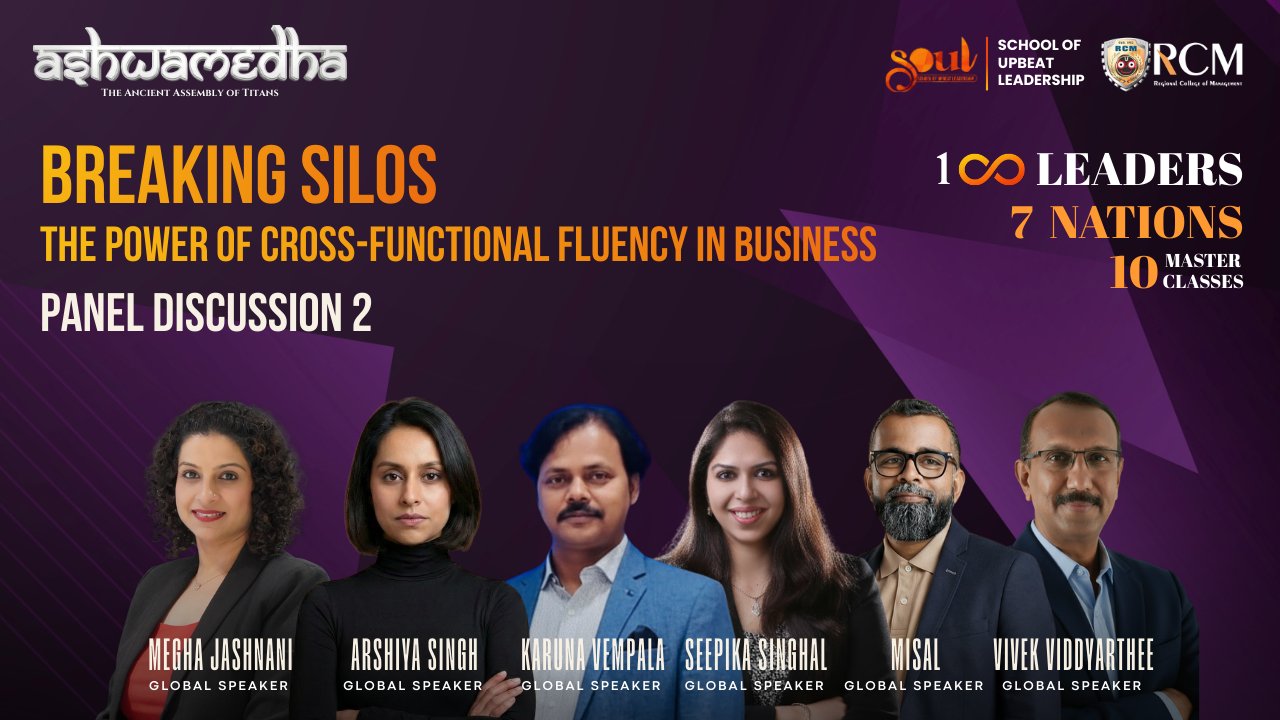
At ASHWAMEDHA 2026, the subtheme “Breaking Silos: The Power of Cross-Functional Fluency in Business” will be explored by distinguished industry leaders:
- Megha Jashnani, Senior Director, Nasdaq
- Arshiya Singh, Director, Boston Consulting Group
- Seepika Singhal, Vice President & India Head, EXL
- Karuna Vempala, Global Head – TA, Covasant
- Misal, TA Head, KPMG
- Hemant Kumar Ravi, Vice President & Global Head, Infogain
These leaders operate at the intersection of strategy, people, and technology. Their insights will focus on dismantling organizational silos, strengthening cross-functional collaboration in business, and building agile leadership for Industry 5.0.
Why This Matters for Future Leaders
Cross-functional collaboration is no longer a soft skill. It is a leadership mandate.
Organizations that master collaborative leadership in organizations outperform competitors in innovation, agility, and resilience.
Institutions like RCM Bhubaneswar are shaping this next generation of leaders through industry-integrated education and global platforms like ASHWAMEDHA 2026.
Visit RCM:
https://rcm.ac.in/
FAQs
It is the coordinated effort of multiple departments working together toward shared organizational goals.
Silos cause misalignment, inefficiency, duplication of effort, and poor decision-making.
Industry 5.0 requires AI-human synergy, collaboration, and ecosystem thinking—all enabled by cross-functional leadership skills.
Communication, systems thinking, empathy, data fluency, and collaborative problem-solving.
Through industry projects, job rotations, simulations, and exposure to global leadership forums like ASHWAMEDHA 2026.
Break Silos. Build Leaders. Shape Industry 5.0.
If you are ready to master cross-functional collaboration in business and gain real-world insights from global industry leaders, this is your opportunity.
Register Now for ASHWAMEDHA 2026:
https://stage.rcm.ac.in/Ashwamedha2026#/
Be part of the leadership movement redefining Industry 5.0 workforce skills.
Your journey toward collaborative, boundaryless leadership begins here.