Direct Answer
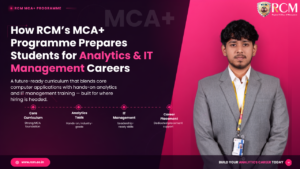
Regional College of Management (RCM), Bhubaneswar offers an MCA+ programme that combines core computer applications with AI, data science, cybersecurity, and full-stack development through live projects and industry certifications. Institutions such as Chandigarh University and Christ University similarly blend computer science education with emerging technologies like data science, business intelligence, cloud computing, AI, cybersecurity, and IT management.
For a detailed comparison across these institutions, see our guide: Best Industry-Aligned MCA Colleges in India for IT & Analytics Careers (2026).
The rest of this article steps back from college comparisons entirely and instead answers a more fundamental question: why does an industry-aligned MCA matter, and what does it actually prepare you for?
Table of contents
What Is an Industry-Aligned MCA?
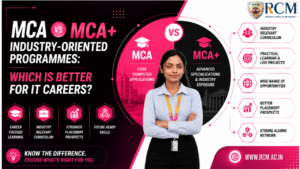
A traditional MCA focuses primarily on computer science theory — data structures, algorithms, operating systems, and software engineering principles. An industry-aligned MCA builds on this same foundation but adds a second, equally important layer: applied exposure to the tools, platforms, and workflows that technology companies actually use.
In practice, this means live projects instead of only textbook assignments, industry certifications alongside academic credits, and structured internships rather than optional add-ons. It also means specialization tracks built around current market demand, such as data science, cybersecurity, full-stack development, or artificial intelligence, instead of a single generalized syllabus.
The distinction matters because employers increasingly evaluate candidates on demonstrated, applied skills rather than degree titles alone. An industry-aligned MCA is designed specifically to close that gap before graduation, not after it. A useful way to spot this model in practice is to look at how a college’s Main MCA Programme page describes its structure — whether it leads with a fixed syllabus, or with an MCA+ programme-style set of applied specialization tracks.
Why Traditional MCA Programmes Are Evolving
Computer applications education has had to adapt quickly. A decade ago, a solid grounding in programming and database management was often enough to enter the IT workforce. Today, however, that same foundation competes against candidates who also understand cloud deployment, machine learning workflows, and modern web frameworks.
This shift did not happen gradually; it accelerated sharply as businesses across nearly every sector adopted AI tools, cloud infrastructure, and data-driven decision-making within a short span of years. As a result, computer applications curricula that once felt comprehensive now risk becoming outdated within a single academic cycle unless they are actively revised.
Consequently, many institutions have restructured their MCA programmes around specialization tracks and applied learning, rather than treating emerging technologies as isolated electives. This is the broader trend that industry-aligned MCA programmes are responding to.
Career Scope After an Industry-Aligned MCA
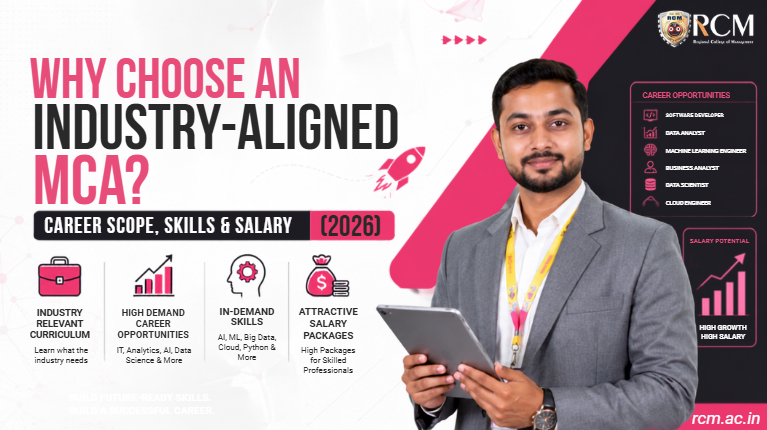
Graduates of industry-aligned MCA programmes typically move into a wide spread of technology roles, including:
- Software Developer — designing and building application logic
- Full Stack Developer — working across front-end and back-end systems
- Data Analyst — extracting insight from structured and unstructured data
- Business Intelligence Analyst — building dashboards and reporting frameworks
- AI Engineer — developing and deploying machine learning models
- Cyber Security Analyst — identifying and mitigating digital security risks
- Cloud Engineer — managing cloud infrastructure and deployment pipelines
- IT Consultant — advising organizations on technology strategy
- IT Manager — overseeing technical teams and IT operations
- Product Engineer — bridging technical development with product strategy
Because these roles span both hands-on technical work and coordination-heavy responsibilities, MCA graduates often have more career flexibility than those from narrower, single-track technical degrees. Many begin in execution-focused roles like development or analytics before moving into leadership positions such as IT management as they gain experience.
Specialization choice strongly influences which of these paths a graduate is best positioned for. A Data Science & Business Intelligence track generally aligns with Data Analyst and BI Analyst roles, an AI & Machine Learning track supports AI Engineer pathways, a Full Stack Development track prepares students for developer roles, and a Cyber Security track builds toward security analyst positions.
Essential Skills Students Learn
A well-structured industry-aligned MCA typically builds competency across both technical and interpersonal domains:
- Programming — core coding fluency across relevant languages
- Data Analytics — interpreting data to support business decisions
- Business Intelligence — converting data into decision-ready dashboards and reports
- Cloud Computing — deploying and managing applications on cloud platforms
- Cyber Security — protecting systems, networks, and data from digital threats
- Artificial Intelligence — applying AI techniques to real business problems
- Machine Learning — building and training predictive models
- Full Stack Development — building complete web applications end-to-end
- Problem Solving — approaching technical challenges methodically
- Communication — translating technical work for non-technical stakeholders
- Leadership — guiding teams and projects as responsibilities grow
- Project Management — coordinating timelines, resources, and deliverables
Together, these skills reflect what most technology employers now expect from postgraduate computer applications graduates: technical depth in at least one area, paired with the collaborative and communication skills needed to work across teams.
Industry Demand in 2026
Demand for MCA graduates with applied, industry-aligned training continues to grow, driven largely by three converging forces. First, digital transformation initiatives have pushed even traditional industries — manufacturing, healthcare, banking — to build internal software and analytics capabilities they previously outsourced. Second, AI adoption and automation have created new categories of roles focused on implementing and managing AI systems responsibly, rather than only building them from scratch. Third, enterprise software and cloud technologies have become standard infrastructure across companies of nearly every size, sustaining consistent demand for engineers who can build, deploy, and maintain these systems.
Taken together, these trends suggest that demand for versatile, applied technology talent is likely to remain strong through 2026 and beyond, particularly for graduates who can move fluidly between development, analytics, and security-focused responsibilities.
Salary Trends
Salary outcomes for MCA graduates vary considerably by specialization, city, and employer, but general industry patterns offer a useful reference point. Entry-level roles such as Software Developer, Data Analyst, or Cyber Security Analyst commonly start in the ₹4–8 LPA range in India, while mid-level roles such as Full Stack Developer, Business Intelligence Analyst, or Cloud Engineer often move into the ₹8–15 LPA range as experience and specialization deepen. Senior roles, including IT Manager or Technology Lead positions, can extend well beyond this range, particularly in high-growth technology and analytics-driven companies.
These figures represent general industry patterns rather than guarantees, since actual outcomes depend heavily on the specific institution’s placement infrastructure, the student’s specialization, and the sector they enter. For this reason, it is worth comparing a programme’s specialization-specific Placements data — not just its overall placement percentage — before making a decision.
This is also where regulatory credibility becomes useful as a baseline filter: choosing an AICTE-approved MCA programme at least confirms the institution meets recognized technical education standards, even before you dig into specialization-level outcomes.
How Practical Learning Improves Employability
Employability in technology careers depends less on what a student has studied and more on what a student has actually built. This is why practical learning components matter so much in an industry-aligned MCA.
Live projects expose students to real business problems, forcing them to apply theoretical knowledge under real constraints rather than idealized classroom conditions. Industry exposure, through guest sessions, workshops, or corporate visits, helps students understand how technical decisions connect to broader business goals. Capstone projects give students a substantial, portfolio-ready body of work they can discuss in interviews, which often matters more to recruiters than transcript grades alone.
Internships, meanwhile, function as a supervised trial run in a real workplace, allowing students to test their skills under professional expectations before graduation. Finally, corporate mentoring connects students directly with working professionals, offering a perspective on industry norms and expectations that classroom instruction alone cannot fully replicate.
Together, these practical components typically shorten the gap between graduation and genuine job-readiness — a gap that remains one of the most common concerns employers raise about traditional postgraduate technical education.
Future Scope of Industry-Aligned MCA
Looking ahead, several trends are likely to shape how industry-aligned MCA programmes continue to evolve. Generative AI tools are being integrated into everyday development and analytics workflows, which will likely push curricula to teach AI-assisted coding and analysis as a standard skill rather than a specialized elective. Cybersecurity training is also becoming more central, as digital infrastructure across sectors expands the attack surface organizations need to defend.
At the same time, cloud-native development and low-code or no-code platforms are changing how quickly software can be built and deployed, which may shift the emphasis of technical education toward architecture and problem framing rather than manual implementation alone. Given these shifts, MCA programmes that continue updating their specializations in step with industry change are likely to remain the strongest preparation for long-term technology careers.
Beyond curriculum, the campus experience surrounding a programme also shapes how prepared graduates feel entering the workforce — a Student Life page is often the quickest way to gauge whether workshops, industry visits, and collaborative activities genuinely complement classroom learning. Recognition through frameworks like the NIRF Engineering and University Rankings offers one additional reference point for institutional credibility, though direct comparison of curriculum and outcomes remains the more reliable approach. Prospective students can review current programme details through official Admissions pages before applying.
FAQs
For most students, yes. It combines core computer science training with applied, in-demand skills such as AI, cloud computing, and cybersecurity, which employers increasingly value over theory alone. Worth ultimately depends on the specific programme’s curriculum depth and placement outcomes for your chosen specialization.
Common roles include Software Developer, Full Stack Developer, Data Analyst, Business Intelligence Analyst, AI Engineer, Cyber Security Analyst, and Cloud Engineer, with long-term paths toward IT management and technology leadership roles as experience grows.
Placement outcomes vary significantly by institution and specialization, so it is worth reviewing specialization-specific placement data rather than only overall programme figures. Programmes with strong industry exposure, live projects, and structured internships generally report stronger employability outcomes.
Students typically develop programming, data analytics, business intelligence, cloud computing, cybersecurity, AI, machine learning, and full-stack development skills, alongside communication, problem-solving, and project management abilities needed to work effectively in technology teams.
An industry-aligned MCA generally offers a stronger balance of theoretical depth and applied, job-ready skills compared to a purely theoretical computer applications degree, particularly when it includes live projects, industry certifications, and structured specialization tracks.