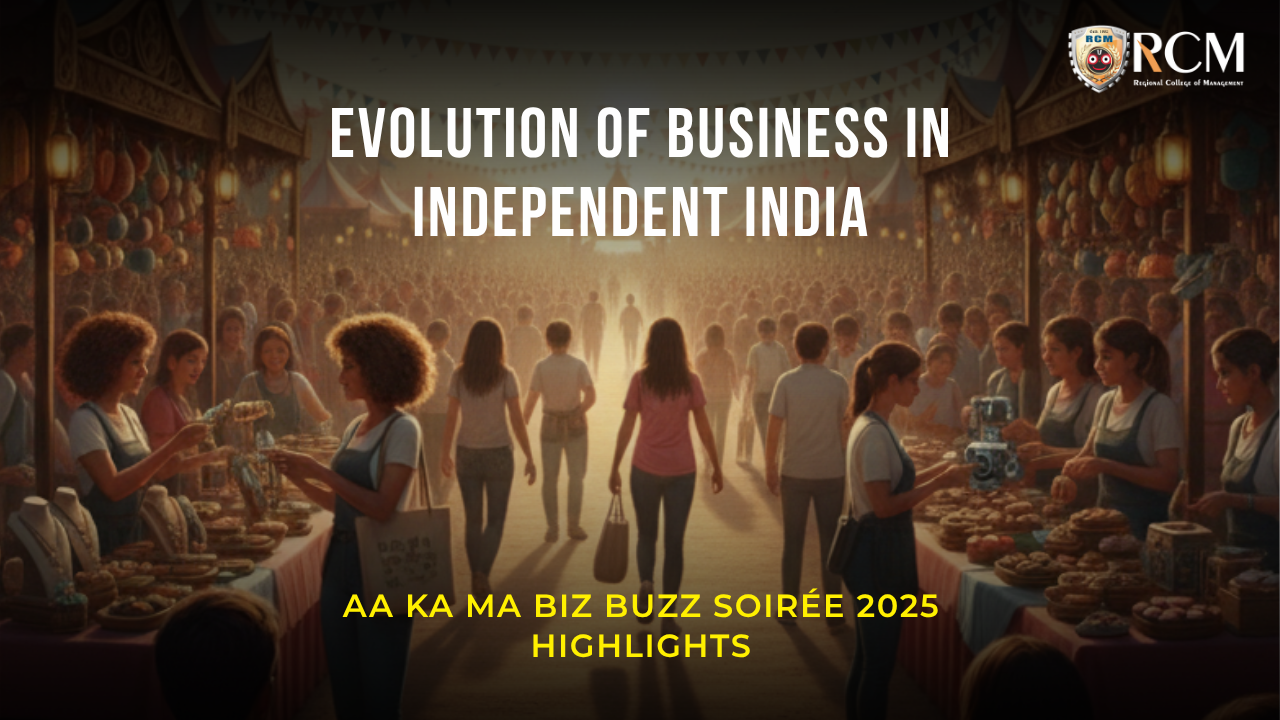
AA KA MA Biz Buzz Soirée 2025 – Pioneering Young Business Wizards
The Regional College of Management (RCM), Bhubaneswar — in collaboration with NHRD Bhubaneswar Chapter and SIDBI — proudly presents the 2nd edition of AA KA MA Biz Buzz Soirée 2025. This dynamic business carnival celebrates the journey of entrepreneurship in India, from ancient trade roots to the modern digital startup revolution.
The theme, “From Tradition to Transformation – Pioneering Young Business Wizards,” perfectly reflects the evolution of business in independent India, celebrating innovation, creativity, and leadership among young entrepreneurs.
Through this event, students from RCM engage in live entrepreneurial projects, collaborating with over 40 SIDBI-recognized entrepreneurs, assisting them in digital branding, strategy making, and business innovation. This unique initiative connects academia with real-world enterprise, establishing RCM as the top management college in Bhubaneswar empowering tomorrow’s business leaders.
Introduction: India’s Business Journey Since 1947
The evolution of business in independent India began with resilience and evolved through reform and reinvention. From an agrarian economy in 1947, India gradually transformed into a global economic powerhouse, demonstrating its ability to adapt and innovate.
At independence, the nation struggled with poverty, limited infrastructure, and low literacy. However, over the decades, through industrialization, policy reforms, and digital progress, India steadily emerged as one of the world’s fastest-growing economies.
Ultimately, this journey reflects the enduring strength of India’s business environment, inspiring today’s entrepreneurs to seamlessly blend tradition with transformation.
Early Economic Policies (1947–1980s): Foundation Years of Industry
In the first four decades after independence, India adopted a state-led planned economy that emphasized public sector growth. Under Prime Minister Jawaharlal Nehru’s vision, the nation’s development followed Five-Year Plans, designed to build self-sufficiency and industrial capacity.
- License Raj: Nearly every business activity required government permission — from manufacturing to imports — restricting private enterprise.
- Public Sector Dominance: Core industries like steel, coal, and energy were under government control to ensure equitable growth.
- “Hindu Rate of Growth”: GDP growth averaged around 3.5% annually, signaling slow progress during this period.
- Green Revolution: The 1960s agricultural transformation turned India from a food-deficient nation to one of self-sufficiency.
Despite these challenges, the foundation for industrial growth in India was laid. Pioneering business families like the Tatas and Birlas continued to operate and innovate within the regulatory framework, planting early seeds of private enterprise.
Economic Liberalization (1991 Reforms): Opening the Gates
The economic reforms in India (1991) marked a historic turning point in the nation’s growth trajectory. Confronted by a severe balance-of-payments crisis, India embraced the LPG model – Liberalization, Privatization, and Globalization.
- The License Raj was dismantled, reducing bureaucratic control and enabling business freedom.
- Foreign Direct Investment (FDI) policies opened the economy to global investors.
- The rise of the IT and services sectors propelled India into the global arena.
- Modernization of capital markets strengthened investor confidence and corporate growth.
These reforms transformed India into a vibrant free-market economy. Cities like Bengaluru, Hyderabad, and Pune became innovation hubs, shaping the country’s modern entrepreneurship landscape.
Rise of Entrepreneurship and Startups (2000s–Present)
Post-liberalization, India entered a new era defined by entrepreneurship, innovation, and digital transformation. Initiatives like Digital India, Make in India, and Atmanirbhar Bharat encouraged self-reliance and technological advancement.
- Startup Ecosystem: India is now the third-largest startup hub globally, with over 100 unicorns.
- MSME Growth: Micro, Small, and Medium Enterprises contribute significantly to GDP and employment.
- Government Initiatives: Startup India and Stand-Up India empower youth and women-led ventures.
The startup revolution in India has democratized business, allowing young innovators to redefine industries through creativity, collaboration, and technology.
Digital Transformation and Globalization
The 21st century witnessed the rapid digital India transformation, reshaping every business sector. With internet penetration, e-commerce, fintech, and AI-driven enterprises, India’s economy became more agile and globally connected.
- E-commerce Expansion: Platforms like Flipkart and Meesho revolutionized retail and logistics.
- Fintech Revolution: Startups such as Paytm and Razorpay empowered financial inclusion.
- Global Integration: Indian IT companies continue to lead digital transformation worldwide.
This shift represents not just modernization but a deep integration of technology into India’s business environment, fostering scalability and innovation.
Women and Youth: Redefining Modern Business
The success of entrepreneurship in India is increasingly driven by women entrepreneurs and youth innovators. Supported by initiatives like Stand-Up India, Skill India, and Startup India, they are challenging stereotypes and reshaping industries.
From rural self-help groups to global technology ventures, women-led enterprises are fueling economic inclusivity. Similarly, India’s youth are driving innovation through sustainability-focused startups and social enterprises — embodying the vision of empowered entrepreneurship.
Sustainable and Green Business Revolution
In the era of climate consciousness, the next wave of transformation focuses on sustainable business in India.
- Green Energy Startups: Solar, wind, and biofuel ventures are reshaping India’s energy sector.
- ESG and Ethical Business Models: Enterprises now prioritize environmental, social, and governance goals.
- Circular Economy Models: MSMEs and startups are innovating with eco-friendly materials and recycling initiatives.
This green economy in India reflects the country’s commitment to sustainability, ensuring economic progress aligns with environmental responsibility.
India @100 – Towards Viksit Bharat 2047
As India moves closer to its centenary of independence, moreover, the vision of Viksit Bharat 2047 strategically outlines a roadmap for inclusive and sustainable growth. Through continued reforms, along with advancing technology, and further strengthened by global partnerships, the nation thus aspires to evolve into a fully developed and inclusive economy by 2047. Consequently, this vision not only charts India’s economic future but also ensures that growth remains equitable, sustainable, and globally competitive.
Furthermore, institutions like RCM Bhubaneswar actively contribute to this transformative journey by nurturing entrepreneurial talent, fostering innovation, and seamlessly connecting academia with industry. Through collaborative initiatives such as the AA KA MA Biz Buzz Soirée 2025, RCM continues to empower young leaders, ensuring that India’s progress remains inclusive, future-ready, and globally competitive.
SOUL – Nurturing Leaders Through Innovation
Moreover, RCM’s School of Upbeat Leadership (SOUL) complements AA KA MA Biz Buzz Soirée by equipping students with essential leadership and managerial skills. Through programs like MDP, FDP, and CSR initiatives, students gain hands-on experience in strategic thinking, problem-solving, and entrepreneurship. As a result, SOUL ensures that RCM students emerge as innovative, ethical, and future-ready leaders, bridging classroom learning with real-world business challenges.
Conclusion: From Tradition to Transformation – Building India’s Entrepreneurial Future
The evolution of business in independent India showcases how resilience, innovation, and adaptability have shaped the nation’s economic identity. From the License Raj to Liberalization, and from industrial growth to the digital India transformation, every phase has prepared India for global leadership.
AA KA MA Biz Buzz Soirée 2025, hosted by the Regional College of Management, captures this spirit of evolution — celebrating the journey of transformation while empowering young minds to lead the next wave of business innovation.
As tradition meets technology, and students collaborate with entrepreneurs, RCM continues to stand as the top management college in Bhubaneswar, driving India’s vision toward Viksit Bharat 2047 — where innovation, inclusivity, and entrepreneurship define the future of business.
Join the movement at AA KA MA Biz Buzz Soirée 2025 — where innovation meets inspiration, and the next generation of entrepreneurs turns ideas into impact. Be part of the transformation that’s shaping the future of business in India.