
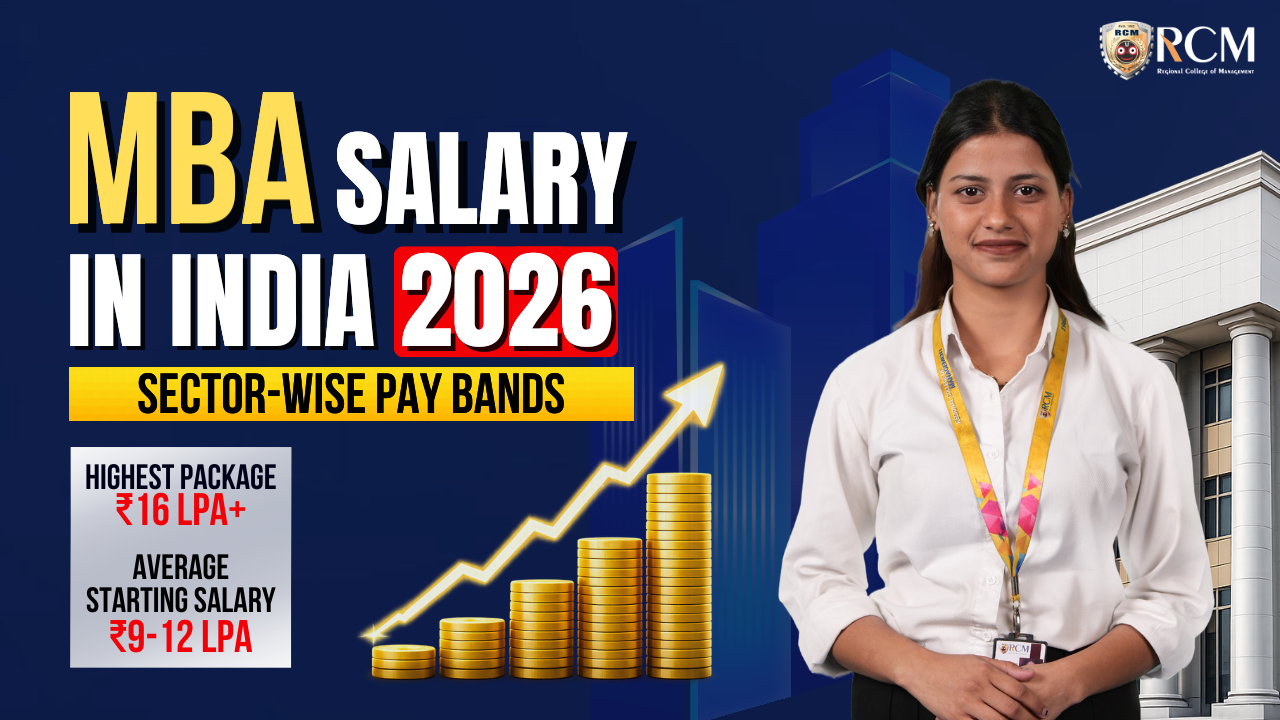
If you’re researching MBA programs, chances are one question keeps coming back to your mind: “What will I actually earn after this?” It’s a fair question — an MBA is a significant investment of time and money, and understanding realistic salary outcomes is essential before you commit to a program.
This guide breaks down MBA salary in India for 2026 using realistic, sector-wise pay bands — not inflated marketing numbers. We’ll cover what freshers typically earn, which specializations and sectors pay the most, how Odisha compares to national averages, and what actually influences your salary beyond just the degree itself.
What is the MBA Salary in India in 2026?
MBA salary in India in 2026 typically ranges from ₹6–12 LPA for freshers, ₹12–25 LPA for high-growth roles such as Product Management, Analytics, and Consulting, while senior professionals can earn ₹30–50+ LPA. Salaries vary by specialization, industry, location, skills, internships, and placement outcomes.
MBA Salary in India 2026: Sector-Wise Pay Bands
| Sector | Common MBA Roles | Starting Salary | Mid-Career Salary |
|---|---|---|---|
| Consulting | Consultant, Strategy Analyst | ₹8–18 LPA | ₹20–40 LPA |
| Product Management | APM, Product Manager | ₹10–20 LPA | ₹25–50 LPA |
| Business Analytics | Analyst, BI Consultant | ₹7–15 LPA | ₹18–35 LPA |
| Banking & Finance | Financial Analyst | ₹7–16 LPA | ₹20–45 LPA |
| FMCG | Management Trainee | ₹6–12 LPA | ₹15–30 LPA |
| Operations & Supply Chain | Operations Manager | ₹6–14 LPA | ₹18–30 LPA |
| Marketing | Brand Manager | ₹6–15 LPA | ₹15–35 LPA |
Note: These are indicative industry ranges based on commonly observed placement trends. Actual offers depend on the institute, individual profile, internships, and the hiring company.
MBA Salary in India 2026 – Understanding the Numbers
Salary numbers can be confusing if you look at them in isolation. A headline figure like “₹20 LPA” might be accurate for one role at one company — but it doesn’t tell you what a typical fresher should expect. Here’s the broader context.
National salary trends show that MBA salaries have grown steadily over the past few years, driven largely by demand in technology-adjacent business roles. According to Glassdoor’s salary data for India, compensation for management roles varies significantly by city, industry, and company size — which is why ranges, not single numbers, are the most honest way to set expectations.
MBA placement trends indicate that companies are increasingly hiring for hybrid roles — positions that combine business strategy with data fluency or technical understanding. This has created a skill premium: candidates who can demonstrate analytics capability, AI tool familiarity, or domain-specific certifications often land offers at the higher end of a sector’s range, while those without these skills tend to land closer to the lower end.
The AI economy impact is visible across almost every function. Roles in AI-driven product management, AI-enabled consulting, and data-led operations are growing faster than traditional generalist management roles — and they tend to pay at a premium because the talent pool with both business and AI fluency is still relatively small.
How Much Do MBA Freshers Earn in India?
The honest answer: it depends heavily on tier, skills, and exposure — more than it depends on the MBA degree alone.
Tier-wise salary expectations vary widely. Graduates from top-tier national institutes can see starting offers well above ₹15 LPA in select roles, while graduates from regional institutes more commonly see MBA starting salary offers in the ₹4–10 LPA range, with higher-end offers going to candidates with stronger profiles.
Skill-based salary differences are significant. Two students from the same college, with the same degree, can receive very different offers based on what they bring beyond the classroom — proficiency in tools like Excel, SQL, Power BI, or familiarity with AI platforms can be the deciding factor between a ₹6 LPA offer and a ₹10 LPA offer.
Internship impact is often underestimated. Students who complete meaningful internships — especially ones involving live projects or measurable outcomes — tend to perform better in placement interviews because they can speak concretely about real work, not just coursework.
Certifications impact is similar. Industry-recognized certifications in analytics, digital marketing, financial modeling, or project management signal to recruiters that a candidate has invested in job-ready skills beyond the core curriculum — and this often translates into better starting offers.
Highest Paying MBA Sectors in 2026
Product Management
Salary range: ₹10–20 LPA starting, ₹25–50 LPA mid-career Growth potential: Very high — product roles are central to how companies build and scale digital offerings. Required skills: User research, prioritization frameworks, data analysis, cross-functional communication.
Consulting
Salary range: ₹8–18 LPA starting, ₹20–40 LPA mid-career Growth potential: High — consulting remains a reliable path into senior strategy and leadership roles. Required skills: Structured problem-solving, client communication, business research, presentation skills.
Investment Banking
Salary range: ₹8–20 LPA starting, ₹25–45+ LPA mid-career Growth potential: High, though competitive and concentrated in financial hubs. Required skills: Financial modeling, valuation, attention to detail, ability to work under pressure.
Business Analytics
Salary range: ₹7–15 LPA starting, ₹18–35 LPA mid-career Growth potential: Very high — analytics roles are expanding across virtually every industry. Required skills: SQL, data visualization tools, statistical reasoning, business storytelling.
Technology Management
Salary range: ₹8–17 LPA starting, ₹20–40 LPA mid-career Growth potential: High — bridges technical teams and business stakeholders. Required skills: Project management, technical literacy, stakeholder management, agile methodologies.
FMCG Leadership Programs
Salary range: ₹6–12 LPA starting, ₹15–30 LPA mid-career Growth potential: Moderate to high — structured leadership programs often lead to fast-tracked promotions. Required skills: Sales and distribution understanding, brand management, on-ground execution.
MBA Salary by Specialization
| MBA Specialization | Average Salary |
|---|---|
| Marketing | ₹6–14 LPA |
| Finance | ₹7–16 LPA |
| HR | ₹5–11 LPA |
| Operations | ₹6–14 LPA |
| Analytics | ₹7–15 LPA |
| Product Management | ₹10–18 LPA |
| Strategy | ₹8–17 LPA |
Note: Averages reflect a broad range across institutes and experience levels; individual outcomes vary based on profile and placement performance.
MBA Salary in Odisha vs India
Regional College of Management (RCM), Bhubaneswar reports an average MBA package of ₹9.5 LPA and a highest package of ₹16 LPA, with a high placement rate across 830+ active recruiters. MBA salaries in Odisha generally range from ₹3.5 LPA to ₹12 LPA. Entry-level freshers typically start between ₹3.5 LPA and ₹5 LPA, while graduates from premier institutions like IIM Sambalpur or XIM University (XUB) secure average packages exceeding ₹11 LPA.
When comparing average MBA salary in Odisha 2026 to national figures, it’s important to set realistic expectations. National averages are pulled upward by metro hubs — Mumbai, Bengaluru, Delhi NCR, and Hyderabad — where cost of living, company concentration, and competition are all higher.
In Odisha, and specifically MBA Bhubaneswar programs, salary ranges tend to be more moderate but come with a different value proposition: significantly lower cost of education and living, combined with growing local opportunities in IT services, BFSI, manufacturing, and emerging sectors like renewable energy and logistics.
The Bhubaneswar ecosystem has been steadily developing as a secondary business hub, with several companies setting up regional offices and development centers in the city. This has created emerging industries demand for management graduates who understand both local market dynamics and broader national business practices — often making the cost-to-outcome ratio for an Odisha-based MBA more favorable than it first appears on paper.
Students evaluating MBA salary potential often look beyond rankings and focus on placement outcomes, industry exposure, and skill development. Institutions such as Regional College of Management (RCM), Bhubaneswar emphasize industry-integrated learning, placement preparation, and corporate engagement that help students become job-ready — which matters more for individual salary outcomes than the city a college is located in.
What Influences MBA Salary?
Beyond the broad ranges above, several specific factors influence where an individual graduate lands within those ranges:
- College reputation — affects which companies visit for campus placements and the initial filter recruiters apply.
- Internships — demonstrate applied experience and often directly influence final placement offers.
- Industry certifications — in analytics, digital marketing, financial modeling, or project management add verifiable, job-ready skills.
- Communication skills — strongly influence interview performance, especially for client-facing and leadership-track roles.
- Analytics capability — increasingly a baseline expectation across marketing, operations, finance, and strategy roles.
- AI literacy — familiarity with AI-powered tools is becoming a differentiator in interviews and on the job.
- Corporate exposure — through live projects, mentorship, or industry interactions helps candidates speak credibly about real business problems.
Why Placement Support Matters
A college’s placement support infrastructure often has as much impact on a graduate’s starting salary as the curriculum itself. Here’s why:
Campus recruitment gives students direct access to companies that might otherwise be difficult to approach independently — particularly for students from smaller cities or first-generation management graduates.
Industry networks built over years allow placement cells to bring in recruiters across diverse sectors, increasing the variety of roles — and salary bands — available to students.
Career services, including resume building, interview preparation, and aptitude training, directly affect how well a student performs when opportunities arise — research from organizations like NASSCOM has consistently highlighted the gap between academic qualifications and job-readiness as a key factor in employability outcomes.
Placement preparation — mock interviews, group discussions, and case-study practice — helps students translate classroom knowledge into the kind of articulate, structured responses recruiters look for.
What Do Placement Outcomes Tell Us?
Placement data is one of the most useful — and most commonly misused — pieces of information when evaluating an MBA program. The key is to look at it transparently: average packages tell you what most students can realistically expect, while highest packages represent strong individual outcomes rather than typical ones.
At RCM, Bhubaneswar, this is reflected in figures such as a highest placement package, alongside more representative average outcomes for the broader cohort. The college’s MBA program is structured around industry recruiters across consulting, analytics, operations, and product roles — the same sectors highlighted in the pay bands above.
For a transparent view of placement trends, recruiter participation, and package distributions, you can review RCM’s placement report directly.
Admission 2026 — Limited Seats
MBA Admissions for 2026 are open at RCM, Bhubaneswar — limited seats available.
Industry-Integrated MBA Program built around real hiring trends | MBA PLUS Program with value-added certifications | Dedicated placement support and corporate recruiter network | Corporate mentorship and live industry projects |Career-focused learning aligned with 2026 salary trends
Talk to admissions about your target package and career goals — explore the full admissions process on the RCM website.
What Salary Can Students Realistically Expect After MBA?
If there’s one takeaway from all the data above, it’s this: range matters more than a single number. A realistic starting point for most MBA graduates in India falls between ₹6–12 LPA, with strong performers in high-demand specializations like analytics, product management, or consulting reaching ₹12–20 LPA at the offer stage.
What moves a candidate from the lower end to the higher end of these ranges isn’t luck — it’s a combination of specialization choice, internships, certifications, communication skills, and the quality of placement support behind them. Two students with identical degrees can have very different outcomes based on these factors, which is why evaluating a program based on its industry exposure and placement ecosystem — not just its brand name — is often the more useful approach.
Conclusion
MBA salary in India for 2026 spans a wide range — from ₹6–12 LPA for typical fresher roles to ₹25–50 LPA for high-growth, specialized positions in consulting, product management, and analytics. What determines where a graduate lands within this range comes down to specialization choice, skill-building through internships and certifications, AI readiness, and — critically — the strength of a program’s placement support ecosystem.
For students in Odisha specifically, the average MBA salary in Odisha 2026 reflects a more moderate but steadily growing market, where the right program can offer strong return on investment relative to cost. Students exploring MBA salary potential, placement outcomes, and career growth opportunities can review RCM’s MBA curriculum, PLUS Program, placement support ecosystem, and admissions information to make a more informed decision for 2026.
FAQs
MBA starting salary in India typically ranges from ₹6–12 LPA for most graduates, with higher-demand specializations and top profiles reaching ₹15–20 LPA.
The highest MBA packages in India can exceed ₹30–50 LPA at top-tier institutes, though such figures represent exceptional individual outcomes rather than typical placements.
Yes, RCM provides dedicated placement support through its MBA PLUS Program, connecting students with 830+ active recruiters across consulting, analytics, operations, and product roles.
For students who actively build relevant skills, gain internship experience, and choose programs with strong placement support, an MBA remains a strong investment in 2026.