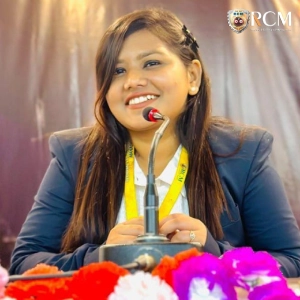
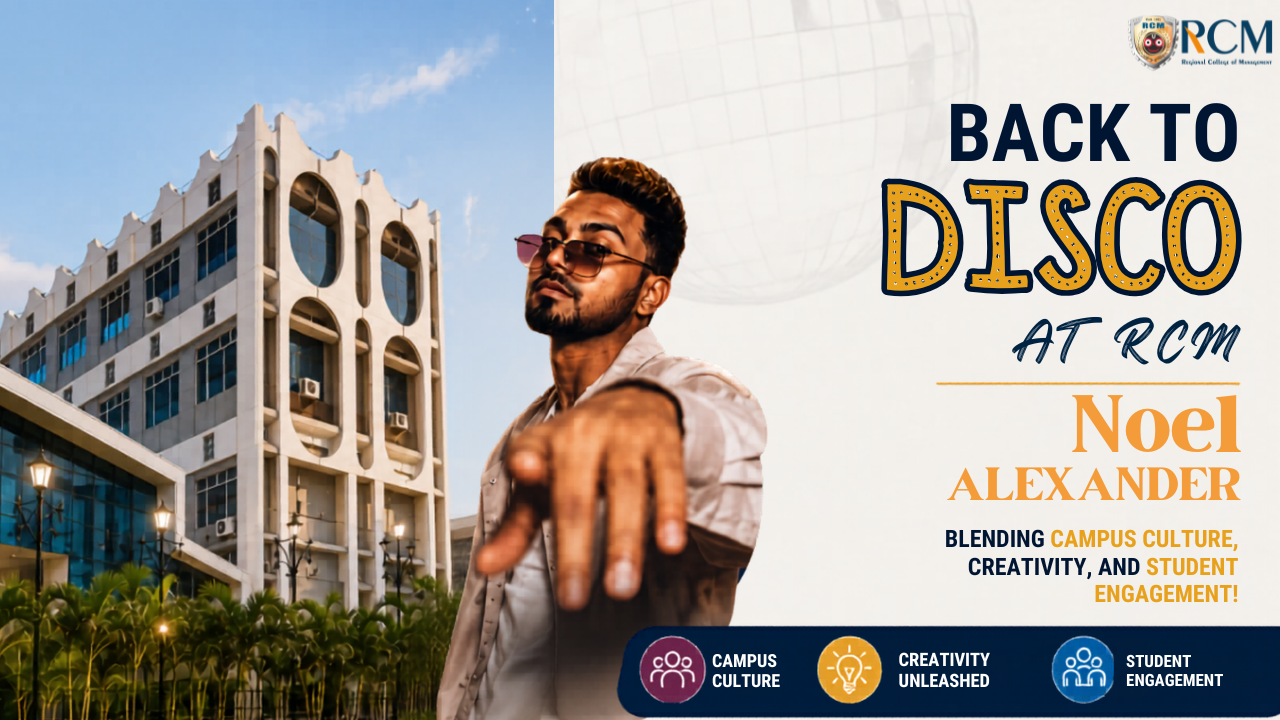
On June 6, Regional College of Management (RCM), Bhubaneswar hosted Back to Disco 2026, a dance workshop led by choreographer Noel Alexander. More than 500 people registered across age groups, turning the Chandrasekharpur campus into a hub of music, movement, and shared energy for a day.
What was Back to Disco 2026?
Back to Disco 2026 was a one-day dance workshop held on June 6 at Regional College of Management (RCM), Bhubaneswar, with RCM serving as the venue partner. Choreographer Noel Alexander led multiple choreography sessions open to participants of all ages, drawing more than 500 registrations.
Quick Facts
| Detail | Information |
| Event Name | Back to Disco 2026 |
| Venue | RCM, Chandrasekharpur, Bhubaneswar |
| Date | June 6 |
| Dance Instructor | Noel Alexander |
| Total Registrations | 500+ |
| Age Group | Open to all ages |
| Session Format | Multiple choreography sessions |
| RCM’s Role | Venue Partner |
| Event Status | Completed |
Table of Contents
- Back to Disco 2026 at RCM: A Celebration Beyond Dance
- Why the Event Drew More Than 500 Registrations
- Inside Noel Alexander’s Dance Workshop
- Why RCM Was Chosen as the Venue Partner
- How Events Like These Shape Student Life at RCM
- Campus Culture at Regional College of Management
- Experiential Learning Beyond the Classroom
- Highlights from Back to Disco 2026
- What Students Learned Beyond Dance
- Frequently Asked Questions
- Conclusion
Introduction
There’s a particular kind of energy that settles over a campus when something other than lectures and assignments is happening — a buzz in the corridors, music drifting from a hall, strangers ending up as dance partners by the second hour. That’s roughly what Chandrasekharpur looked like on June 6, when Regional College of Management (RCM), Bhubaneswar opened its doors as the venue partner for Back to Disco 2026, a dance workshop led by choreographer Noel Alexander.
By the time the sessions wrapped up, more than 500 people had registered and taken part — students, dance enthusiasts, and curious first-timers, with no age bar keeping anyone out. The event has already concluded, but what it left behind is worth talking about: a clear example of how a college campus can become more than just a place to attend class, and why that matters for the people who study there.
Back to Disco 2026 at RCM: A Celebration Beyond Dance
Workshops like Back to Disco 2026 rarely succeed because of the dance alone. They work because of what happens around the dancing — the registration desk buzzing with first-time attendees, the playlist changes between sessions, the small groups practicing a step in a corner before the next round begins. On June 6, that’s exactly the atmosphere RCM’s campus took on for a day.
The event wasn’t organized as a college fest or an internal cultural program. It was an independently run dance workshop that needed a venue capable of handling several hundred participants comfortably, and RCM stepped in as that venue partner. For a campus that usually hosts lectures, seminars, and placement drives, hosting a public dance workshop was a different kind of day — and one that fit naturally into how the institution thinks about using its space.
What made it notable wasn’t scale alone. It was the mix of people in the room. Long-time dance learners showed up alongside people trying a structured workshop for the first time. That range is part of why the event is worth documenting here: it says something about appetite for this kind of experience in Bhubaneswar, and about the kind of campus that’s willing to host it.
Why the Event Drew More Than 500 Registrations
Numbers alone don’t explain why an event works, but they do tell you something. Crossing 500 registrations for a single-day workshop, with no age restriction, suggests the appeal went well beyond college students looking for a weekend activity.
A few things likely contributed. First, Bhubaneswar’s calendar for structured dance workshops led by a recognized choreographer isn’t packed — when one comes along, people who’ve been waiting for exactly this kind of opportunity tend to show up. Second, removing the age restriction widened the pool considerably. Parents, working professionals, and school-going teenagers could all register under the same banner, and many did. Third, multiple choreography sessions meant the workshop wasn’t a one-shot, one-style event; there was enough variety across the day that different kinds of participants found a session that suited their pace and interest.
There’s also a simpler explanation: word of mouth. Dance workshops tend to attract people in groups — friends signing up together, dance-class batches attending as a unit. Once registrations start moving, that momentum tends to build on itself, especially in a city where this kind of community event doesn’t happen every week.
Inside Noel Alexander’s Dance Workshop
At the center of the day was Noel Alexander, the choreographer leading the sessions. Across the multiple choreography rounds, the structure allowed participants to move from foundational steps to more involved sequences as the day progressed, without assuming everyone in the room had the same starting point.
That’s a harder balance to strike than it sounds. A workshop with 500-plus registrants, spanning age groups and experience levels, can’t run as a single uniform class. Breaking the day into multiple sessions gave the format room to address that — newer participants could ease into the basics, while more experienced dancers had sessions that pushed further into technique and choreography.
What stood out about the format wasn’t novelty for its own sake. It was the kind of structured, hands-on learning that’s genuinely difficult to replicate outside a live workshop setting — the immediate correction, the energy of learning a sequence alongside dozens of other people, the small wins that come from getting a transition right after a few tries. That’s the kind of experience a video tutorial doesn’t quite recreate.
Why RCM Was Chosen as the Venue Partner
Hosting 500-plus participants for a multi-session event isn’t a small logistical ask. It needs adequate floor space, the ability to manage entry and movement for large groups, and infrastructure that can support a day-long program without bottlenecks. Regional college of management campus was equipped to handle exactly that, which is the practical reason it made sense as a venue partner.
But there’s a less obvious reason too. Colleges that regularly open their campuses to events beyond their own academic calendar tend to develop a certain reputation — as places that are comfortable hosting public programs, not just internal ones. RCM has hosted workshops, guest sessions, and activities involving people outside its student body before, and that track record likely made it a natural fit when organizers were looking for a venue that could accommodate a public dance workshop at this scale.
It’s also worth noting what this arrangement signals about how RCM thinks about its campus. A college that treats its infrastructure purely as classroom space rarely ends up hosting something like a city-wide dance workshop. Choosing to be the venue partner for Back to Disco 2026 reflects an openness to using that space for activities that serve the broader community, not only the institution’s own students.
How Events Like These Shape Student Life at RCM
For students who attend a college like RCM, days like June 6 add something specific to the overall experience of being on campus — proximity to things happening outside the syllabus. Even students who didn’t personally register for the workshop got to see what it looks like when a campus turns into a venue for hundreds of outside participants for a day.
That proximity matters more than it might seem. Student life isn’t only built from classes, internal fests, and exam schedules. It’s also built from the smaller, cumulative experience of being part of a campus that does things — that hosts, that participates, that opens its gates to programs beyond its own four walls. Students pick up on that. It shapes how they talk about their college to friends outside it, and it shapes their own sense of what’s possible on the campus they spend years of their life on.
There’s also a quieter benefit: exposure. A student walking past a 500-person dance workshop in progress is getting a small, low-stakes lesson in event scale, crowd management, and live coordination — the kind of thing that’s easy to underestimate until you’re the one organizing something yourself.
Campus Culture at Regional College of Management
Culture on a campus isn’t really visible in a brochure. It shows up in what a campus chooses to do with its time and space outside the timetable. RCM has built a reasonably consistent pattern here — workshops, guest interactions, cultural activities, and now, a city-scale dance event hosted as venue partner.
None of these, on their own, define an institution. But taken together, they describe a campus that doesn’t treat extracurricular activity as an afterthought squeezed into a single annual fest. Back to Disco 2026 fits into that broader pattern rather than standing apart from it — another instance of the same underlying approach: if there’s a worthwhile activity that benefits students and the wider community, RCM is generally willing to make space for it, literally and otherwise.
That kind of consistency is what eventually becomes “culture” in any real sense. A single big event doesn’t build a reputation. A pattern of smaller, repeated choices does.
Experiential Learning Beyond the Classroom
There’s a reason management institutes talk so much about experiential learning, and it isn’t just a textbook phrase. Skills like coordination, adaptability, and working with people you’ve never met before are genuinely difficult to teach through lectures. They’re far easier to absorb by being in the middle of something live — a workshop, an event, a room full of people trying to learn the same sequence at the same time.
Back to Disco 2026 is a good example of this principle in action, even though it wasn’t an academic exercise. Students who were part of the day — whether dancing, watching, or simply present on a campus mid-event — were absorbing something experiential: how a large gathering is paced, how instructions move efficiently across a crowd, how energy in a room can be managed and sustained for hours.
This is the same underlying logic that connects a dance workshop to a management classroom more than it might initially seem to. Both are about reading a room, managing time, and getting a large number of people aligned toward a shared outcome — skills that show up again later, in very different settings.
Highlights from Back to Disco 2026
- More than 500 participants registered, with no age restriction in place
- Choreographer Noel Alexander led multiple choreography sessions across the day
- RCM, Chandrasekharpur, served as the official venue partner
- Sessions accommodated a wide range of experience levels, from first-timers to trained dancers
- The event ran smoothly across its full schedule on June 6
- The day reflected a broader culture of hosting student-relevant, community-facing events on campus
What Students Learned Beyond Dance
Strip away the music and the choreography, and a few quieter lessons remain for anyone who was part of organizing, attending, or simply observing the day. Coordinating registrations for 500-plus people requires planning. Managing the flow of multiple sessions across a single day requires timing. Keeping a large, mixed-age crowd engaged for hours requires reading energy levels and adjusting on the fly.
These are the same skills that show up, almost word for word, in conversations about leadership, teamwork, and confidence — three things colleges talk about constantly but rarely get a live, visible example of in action. Back to Disco 2026 offered exactly that. Whether a student danced in every session or simply walked past the venue between classes, the day was a small, real-world demonstration of what it takes to plan and run something at scale.
Confidence, in particular, tends to build less from being told to be confident and more from being placed in situations — a new dance step, an unfamiliar room full of strangers, a session led by someone you’ve never met — and getting through them. That’s a harder thing to manufacture in a classroom than it is to simply let happen on a day like June 6.
Frequently Asked Questions
1. What was Back to Disco 2026 at RCM?
Back to Disco 2026 was a dance workshop hosted at Regional College of Management (RCM), Bhubaneswar, featuring choreographer Noel Alexander and attracting more than 500 participants for a day of learning and student engagement.
2. Who conducted the dance workshop at RCM?
The workshop was led by choreographer Noel Alexander, who guided participants through multiple choreography sessions focused on creativity, confidence, and performance across the day.
3. Why was RCM chosen as the venue partner?
RCM was selected because of its vibrant campus culture, adequate infrastructure for large gatherings, and established track record of hosting student-relevant and community-facing events.
4. How does RCM support extracurricular learning?
RCM regularly hosts workshops, guest sessions, cultural activities, and similar programs that give students exposure to experiences beyond the standard academic curriculum.
5. Why are campus events like Back to Disco important?
Campus events build teamwork, adaptability, and confidence by placing students in real, live situations, making them a meaningful part of student development alongside classroom learning.
Conclusion
Back to Disco 2026 has already concluded, but the day it gave Chandrasekharpur is a useful snapshot of what a college campus can be when it’s used for more than timetables and term exams. More than 500 participants, a choreographer guiding sessions for everyone from first-timers to seasoned dancers, and a campus willing to open itself up as venue partner for a day — together, that’s a small but clear picture of what experiential, community-connected campus life can look like.
For RCM, hosting this workshop wasn’t a one-off gesture. It fits a broader, ongoing pattern of using campus space for activities that extend past the classroom — the kind of pattern that, over time, becomes part of what people mean when they talk about a college’s culture.
Curious what else happens on campus beyond academics? Explore RCM’s Campus Life and Events pages, or learn more About RCM, its Student Clubs, and ongoing Placements support. Prospective students interested in joining a campus that treats extracurricular experience as part of the larger education can check Admissions, including details on the MBA and BBA programs.