A decade ago, “financial analysis” meant a spreadsheet, a calculator and a fair amount of guesswork about what the market would do next. Today, the same decision — whether to approve a loan, flag a suspicious transaction, or rebalance a portfolio — increasingly runs through a machine-learning model before a human ever looks at it. That shift is what most people mean when they talk about AI in finance: not a single product, but a quiet reorganisation of how banks, investors and regulators make decisions.
For finance students in India — whether in a BBA, BCA, MBA, PGDM, MCA or M.Com programme — this shift is no longer background noise. Recruiters increasingly expect graduates to understand not just balance sheets and valuation, but how artificial intelligence in finance is changing credit assessment, fraud detection, investment research and compliance. This article walks through what’s established, what’s emerging, and what’s still genuinely uncertain — without pretending AI has solved problems it hasn’t.
Table of contents
- What Is AI in Finance?
- Why Is AI Important for the Financial Services Industry?
- How Is Artificial Intelligence Transforming Financial Services?
- Key Benefits of AI in Finance
- Challenges and Risks of AI in Financial Services
- What Are the Major AI in Finance Trends to Watch?
- How AI and Sustainability Are Connecting in Modern Finance
- How CAPXCHANGE 2026 Connects AI, Finance and Sustainable Innovation
- What Skills Do Students Need to Build for AI-Driven Finance?
- Conclusion
- FAQS
What Is AI in Finance?
What Is AI in Finance?
AI in finance refers to the use of machine learning, natural language processing and related technologies to analyse financial data and support decision-making. In practice, this means faster fraud detection, more consistent credit assessment, automated risk monitoring, financial forecasting, and AI-assisted banking and investment services — generally working alongside human judgement rather than replacing it entirely.
In simple terms, artificial intelligence in finance covers several overlapping technologies. Machine learning models learn patterns from historical financial data to predict outcomes like default risk or fraud. Natural language processing lets systems read and summarise financial documents, news, and regulatory filings. Predictive analytics uses statistical models to forecast cash flow, demand or market movement. Computer vision helps with document verification during onboarding. And generative AI — the newest addition — can draft reports, summarise research and answer natural-language questions about financial data.
None of these technologies work in isolation from human oversight. A credit model can flag risk, but a lending decision still typically involves policy rules, compliance checks and, for larger exposures, a human underwriter. That distinction — AI as a decision-support layer rather than a decision-maker — runs through almost every serious discussion of AI banking and AI risk management today.
Why Is AI Important for the Financial Services Industry?
Financial institutions generate enormous volumes of data every day — transactions, market feeds, customer interactions, regulatory filings. Reviewing all of it manually was never realistic at scale, and that gap is precisely where AI has found its footing in financial services.
- Speed: Fraud and anomaly patterns that once took days to surface can now be flagged in near real time.
- Personalisation: Banking apps can tailor spending insights, offers and alerts to individual customer behaviour.
- Operational efficiency: Routine tasks — document checks, query handling, reconciliation — can be partly automated, freeing analysts for judgement-heavy work.
- Better forecasting: Predictive models can support (not guarantee) more informed views on cash flow, demand and market conditions.
- Financial inclusion: Alternative-data-based credit assessment can help extend services to customers with thin or no traditional credit history, where done responsibly.
The important caveat, repeated by regulators and researchers alike, is that none of this makes financial decision-making infallible. AI can improve the speed and consistency of analysis; it does not eliminate the need for human oversight, especially where a decision affects someone’s access to credit or savings.
How Is Artificial Intelligence Transforming Financial Services?
AI in Banking
Most people’s first encounter with AI banking is a chatbot resolving a balance query or a fraud alert on a card transaction. Behind the scenes, banks also use AI for transaction pattern analysis, credit assessment support, and increasingly personalised digital banking experiences — recommending savings products or flagging unusual spending based on a customer’s own history rather than generic rules. Students exploring this intersection of banking, technology and strategy often find a natural academic pathway in Finance and FinTech specialisations, which sit within RCM’s broader MBA+ track. On the regulatory side, the Reserve Bank of India resources page is a useful primary source for how India’s central bank is approaching digital payments and banking innovation more broadly.
AI in Fraud Detection and Financial Crime Prevention
Fraud detection is one of the more mature applications of AI in financial services. Machine-learning models compare a transaction against a customer’s typical behaviour and flag deviations — an unusual location, an atypical amount, an odd time of day — for review. This pattern-recognition approach also supports anti-money-laundering monitoring, where systems scan large transaction volumes for suspicious clusters. Crucially, an AI flag is a starting point, not a verdict: real investigations, regulatory reporting and final decisions still involve human analysts and, where required, law enforcement.
AI in Risk Management
AI risk management spans credit risk, market risk, operational risk and liquidity risk. Predictive models can support scenario analysis — for instance, estimating how a portfolio might behave under a given stress scenario — and can monitor exposures more continuously than periodic manual reviews. But this comes with its own governance requirement: any model used for risk decisions needs validation, documentation and periodic review, because a flawed or outdated model can itself become a source of risk (a concern regulators refer to as “model risk”).
AI in Credit Scoring and Lending
Traditional credit scoring relies on repayment history and formal financial records. AI-based credit assessment can incorporate a wider range of data — utility payments, transaction patterns, and other legally permissible sources — potentially extending credit access to applicants who lack a long formal credit history. This is a genuine financial-inclusion opportunity, but it carries real fairness risks: a model trained on historical data can inherit historical biases, and a rejected applicant deserves an explainable reason, not a black-box score. Responsible lenders combine AI-based scoring with human review and bias testing rather than fully automated decisions.
AI in Investment and Wealth Management
In investment and wealth management, AI supports portfolio analysis, market-sentiment analysis of news and social data, and robo-advisory tools that generate recommendations based on a client’s stated risk profile. These tools can improve the speed and breadth of research a single analyst can cover. They are not a substitute for investor suitability assessment — an AI-generated recommendation still needs to be checked against a client’s actual goals, time horizon and risk tolerance, which is why most serious wealth-management platforms keep a human adviser in the loop for anything beyond routine rebalancing.
Generative AI in Finance
Generative AI is the newest and fastest-moving layer. Finance teams are experimenting with it for document analysis, financial research summarisation, internal knowledge assistants, and even basic code or workflow assistance. The upside is real: a generative model can summarise a lengthy regulatory filing in seconds. The risk is equally real — generative models can “hallucinate” plausible-sounding but incorrect figures, and feeding confidential financial data into an ungoverned AI tool raises genuine data-leakage concerns. The IMF’s analysis of generative AI in finance is a useful reference here — it frames generative AI as reshaping both the opportunities and the risk landscape for financial institutions, including new categories of model and concentration risk that supervisors are still learning to monitor. Students curious about the technical side of this — how these models are actually built and deployed — can explore it through AI and Machine Learning under RCM’s MCA+ track.
AI in Compliance and Regulatory Technology
RegTech — regulatory technology — is one of the quieter but more consequential uses of AI in finance. AI-assisted tools can support Know Your Customer (KYC) checks, anti-money-laundering document review, and audit-trail generation, reducing the manual burden of compliance work. Human accountability remains central here: regulators expect a named, accountable individual behind any AI-assisted compliance decision, not an algorithm alone. For readers interested in India’s market-regulation side of this, SEBI’s official resources cover investor protection and market-governance frameworks that increasingly intersect with fintech and AI-driven products.
AI, Cybersecurity and Digital Financial Protection
AI cuts both ways in cybersecurity. On the defensive side, it powers behavioural-analysis tools that detect account takeovers and phishing attempts in digital banking. On the offensive side, the same class of technology can be used to generate more convincing phishing content or automate attack attempts — meaning financial institutions are effectively in an AI-versus-AI arms race on security. This dual-use reality is exactly why cybersecurity is now treated as core financial-technology infrastructure rather than a back-office IT function, an area covered in depth through cloud and cybersecurity specialisation within MCA+.
Key Benefits of AI in Finance
The benefits of AI in financial services are real, but they are best framed as potential and conditional rather than guaranteed. The table below summarises where AI can help — and what to keep in mind before assuming it always will.
| Application | Potential Benefit | Important Consideration |
|---|---|---|
| Fraud detection | Can flag suspicious activity faster than manual review | Requires human investigation before action is taken |
| Credit assessment | May support faster, more consistent evaluation | Needs bias testing and an explainable decision path |
| Risk monitoring | Can enable more continuous portfolio and exposure tracking | Models need regular validation to avoid model risk |
| Customer experience | Has the potential to personalise banking and advisory interactions | Data privacy and consent must be actively managed |
| Cost efficiency | Can help institutions automate routine, high-volume tasks | Automation savings should not come at the cost of oversight |
| Financial inclusion | May extend credit access via alternative data | Alternative data sources must be used lawfully and fairly |
| Forecasting | Can improve the breadth and speed of data-driven forecasting | Forecasts remain probabilistic, not guaranteed outcomes |
Challenges and Risks of AI in Financial Services
No honest discussion of AI in finance can skip its risks. These are not hypothetical — they are actively discussed by regulators, academics and institutions rolling out these tools today.
Data privacy and security
AI systems in finance run on sensitive personal and transactional data, which raises the stakes on data protection, storage and consent considerably higher than in most other industries.
Algorithmic bias and fairness
A model trained on historically biased data can reproduce — or even amplify — that bias in lending, hiring or pricing decisions, unless it is actively tested and corrected for.
Lack of explainability
Many advanced AI models are effectively “black boxes.” When a decision affects someone’s access to credit or insurance, regulators and customers alike increasingly expect an explanation, not just a score.
Generative AI hallucinations
Generative tools can produce confident, well-written, and factually wrong output — a serious concern when the output touches financial figures, compliance text or client communication.
Model risk and validation
A model that performed well historically can degrade as market conditions change. Ongoing validation, not a one-time check, is what keeps model risk manageable.
Regulatory uncertainty
AI regulation in finance is still evolving globally and in India, which means institutions are often building governance frameworks ahead of settled rules rather than after them.
Cybersecurity threats
As noted above, AI is a tool available to attackers as well as defenders, raising the bar on financial-sector cybersecurity investment.
Workforce transformation and human oversight
AI is generally expected to augment financial roles — automating routine analysis while shifting human effort toward judgement, client relationships and governance — rather than eliminate the profession outright. That transition still requires deliberate reskilling, not just faith that “AI will handle it.”
What Are the Major AI in Finance Trends to Watch?
- Generative AI copilots for finance and research teams
- AI-powered fraud and scam detection at scale
- Growing emphasis on explainable and responsible AI
- AI-driven risk analytics and continuous monitoring
- Intelligent automation in retail and corporate banking
- AI-enabled financial inclusion through alternative-data lending
- Real-time payments paired with real-time fraud intelligence
- More personalised, AI-assisted financial guidance
- AI applied to sustainable and green finance analysis
- Regulatory technology (RegTech) maturing alongside AI adoption
- AI governance and model-risk management becoming standard practice
- Multimodal financial analysis combining text, numbers and images
Not every trend on this list is equally mature — some, like fraud detection, are well-established; others, like fully explainable generative AI in regulated finance, are still very much in progress. It’s worth treating “trend” as “direction of travel,” not “already universal.”
How AI and Sustainability Are Connecting in Modern Finance
One of the more interesting intersections in AI in finance right now is with sustainable and green finance. AI-assisted tools are increasingly used to analyse ESG (Environmental, Social and Governance) data, model climate-related risk, screen investments against sustainability criteria, and process supply-chain emissions data at a scale manual analysis could not match. For students drawn to this space, Green Finance & ESG (FinTech) under RCM’s PGDM+ pathway builds directly on this theme, as does the parallel Green Finance & ESG (FinTech) track within BBA+.
The honest limitation here is data quality. ESG datasets are often incomplete, inconsistently reported, or self-disclosed by the companies being assessed — which means an AI model built on unreliable ESG inputs will produce unreliable ESG outputs, no matter how sophisticated the model itself is. That’s precisely why responsible AI practices and sustainable-finance analysis increasingly need to be discussed together rather than as separate concerns, a connection that development institutions like the World Bank research and resources have highlighted in the context of financial inclusion and climate-linked development finance.
How CAPXCHANGE 2026 Connects AI, Finance and Sustainable Innovation
This intersection of AI in finance, sustainability and financial innovation is exactly the ground covered by CAPXCHANGE 2026, a two-day Finance Conclave hosted by Regional College of Management (RCM), Bhubaneswar, on 18–19 September 2026, built around the theme “Green Finance, Smart Future: Redefining Wealth in the Age of AI and Sustainability.”
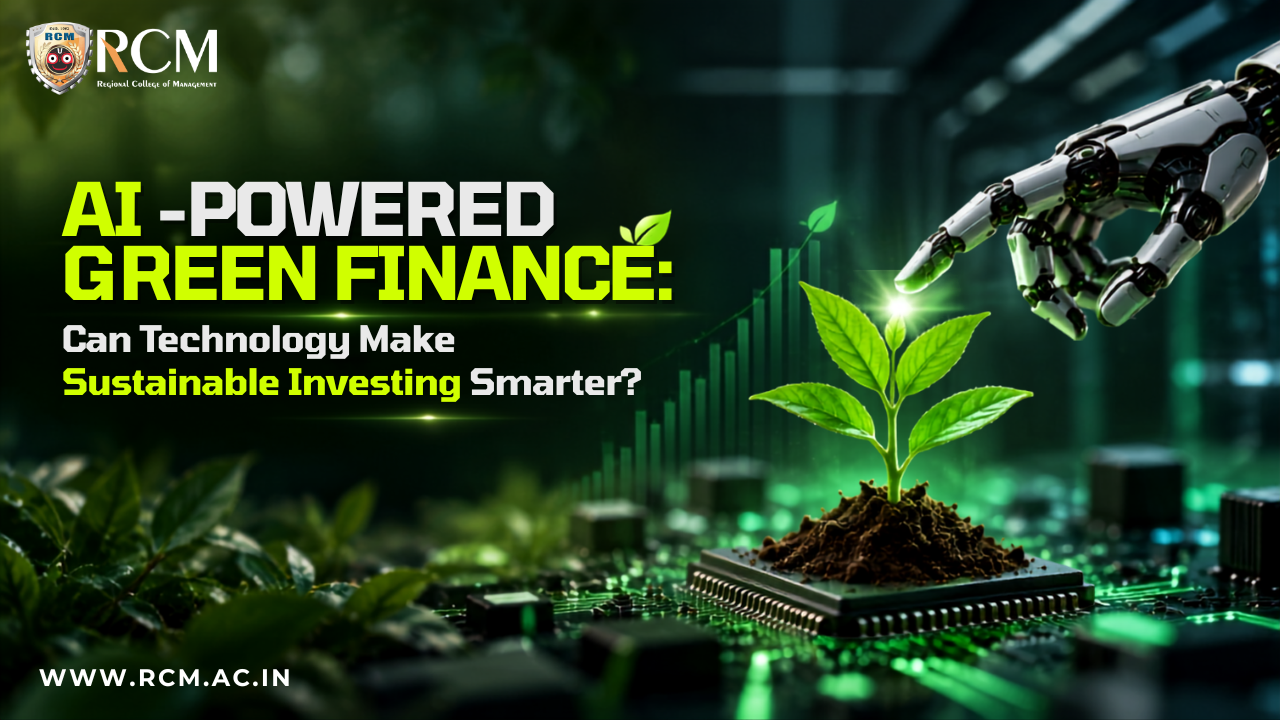
The conclave brings together finance professionals, corporate leaders, academicians and students through keynote addresses, masterclasses and panel discussions — including a Day 2 session titled “AI-Powered Green Finance: Can Technology Make Sustainable Investing Smarter?” that examines how AI, ESG intelligence and predictive analytics are shaping sustainable investment decisions. Alongside the panels, the event’s Financial Technology Innovation track invites student presentations on themes spanning AI in Finance, generative AI, FinTech and digital payments, wealth management, ESG investing, blockchain and digital banking, financial inclusion, and cybersecurity — essentially a snapshot of the same themes this article has walked through. The Financial Modelling WorldCup, running alongside it, gives participants a more hands-on route into practical finance skills: financial modelling, valuation, forecasting, DCF, WACC, comparable-company analysis, and scenario and sensitivity analysis.
Related reading: India’s Biggest Finance Conclave 2026: Complete Guide to CAPXCHANGE covers the full two-day schedule, speaker line-up and competition details.
What Skills Do Students Need to Build for AI-Driven Finance?
Employers hiring for AI-adjacent finance roles are rarely looking for a pure technologist or a pure finance graduate — they’re looking for someone who can move between both worlds. Based on where the industry is heading, a reasonably complete skill set includes:
- Solid financial literacy and corporate-finance fundamentals
- Accounting basics and the ability to read financial statements
- Data analysis, statistics and probability
- Excel and financial modelling
- Business intelligence and data visualisation
- Basic programming awareness (commonly Python)
- AI and machine-learning fundamentals — not deep engineering, but working literacy
- Cybersecurity awareness
- ESG and sustainable-finance knowledge
- Critical thinking, so professionals interpret AI outputs rather than accept them at face value.
- Communication and presentation skills
- Ethics and responsible decision-making
In short: finance knowledge, technology awareness, analytical thinking and ethical judgement, combined rather than siloed. Practically, this means following FinTech developments, building small financial-model projects, learning basic data visualisation, and — where possible — testing these skills in a live setting. Competitions and conclaves such as CAPXCHANGE offer exactly that kind of practice: presenting an idea, defending a model, or discussing AI-and-ESG questions in front of working professionals rather than only in a classroom. Foundational programmes like BBA+, with tracks such as Business Analytics, and technical programmes like MCA+, including Data Science and Business Intelligence, are two of the more direct academic routes into this combination.
Conclusion
AI in finance is best understood as a redefinition of how financial services get built and delivered, not a wholesale replacement of the people who build and deliver them. Fraud detection, credit assessment, risk monitoring and investment research are all becoming faster and more data-driven — but every credible application still keeps a human accountable for the outcome, precisely because bias, hallucination and model risk are real and unresolved challenges, not edge cases.
For students and early-career professionals, the practical takeaway is straightforward: the finance professionals who combine solid financial fundamentals with genuine AI literacy, data skills and ethical judgement will be the ones best positioned as the industry keeps changing. Events, coursework and competitions that put these themes in front of working professionals — rather than only in a textbook — are one of the more useful ways to build that combination early.
FAQS
AI in finance is the use of machine learning, natural language processing and related technologies to analyse financial data and support decisions such as fraud detection, credit assessment, risk monitoring and forecasting — generally alongside, not instead of, human judgement.
Financial institutions handle enormous volumes of transaction and market data that manual review cannot process at scale. AI helps analyse this data faster, supports more consistent decision-making, and can improve personalisation, fraud detection and operational efficiency.
Banks use AI for chatbots and virtual assistants, transaction pattern analysis, fraud monitoring, credit-assessment support, and personalised digital banking experiences that tailor alerts and offers to individual customer behaviour.
AI supports risk management by enabling more continuous monitoring of credit, market, operational and liquidity risk, and by assisting scenario analysis. It requires ongoing model validation and governance to avoid introducing new “model risk.”
Generative AI in finance refers to tools that can draft, summarise or answer questions about financial documents and research. It offers speed and efficiency gains but carries risks such as hallucinated figures and data-confidentiality concerns.
CAPXCHANGE 2026 explores AI, FinTech, ESG and green finance through keynotes, panels and student innovation at RCM Bhubaneswar.