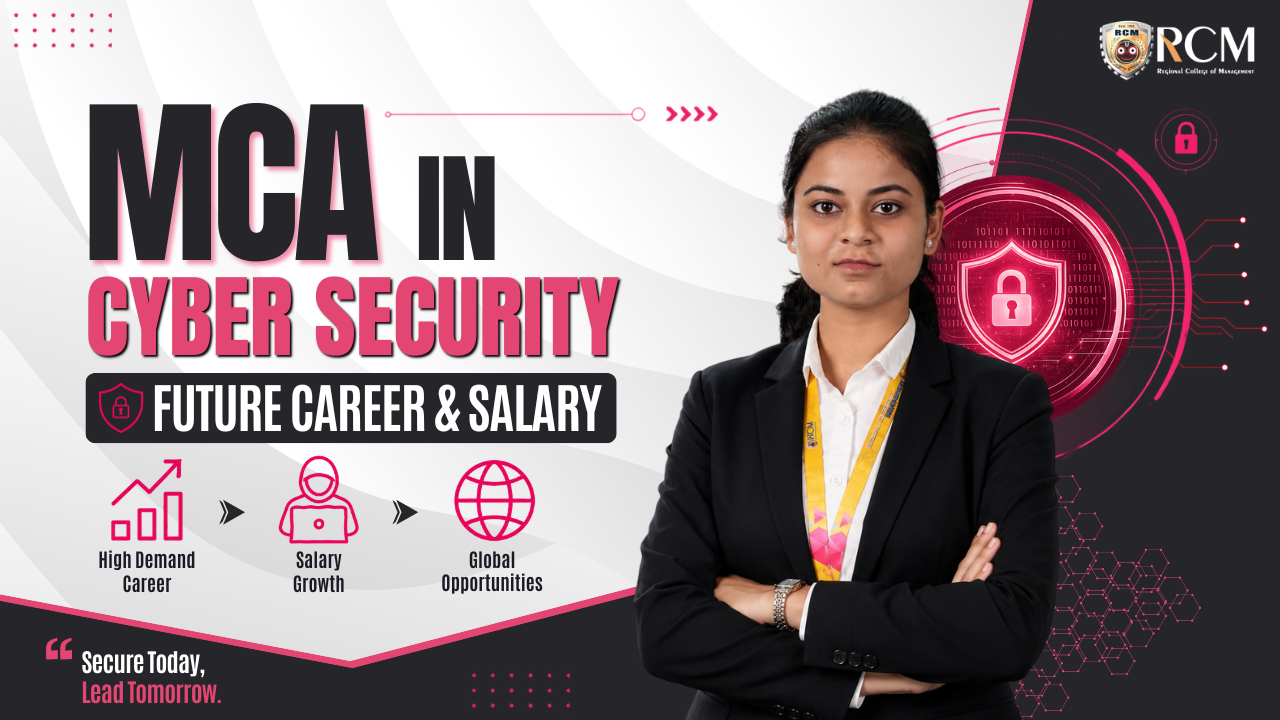
Cyber attacks are growing faster than most organizations can defend against them, and AI-powered threats are only widening that gap in 2026. As digital transformation pushes more of banking, healthcare, and government online, global demand for skilled cybersecurity professionals keeps climbing. That combination is exactly why MCA Cyber Security has become one of the strongest MCA specializations available today.
Table of contents
- Quick Answer
- What is MCA in Cyber Security?
- Why Choose MCA Cyber Security in 2026?
- MCA Cyber Security Course Curriculum
- MCA Cyber Security Admission Process
- Why Choose Regional College of Management (RCM), Bhubaneswar for MCA Cyber Security?
- Skills You Learn in MCA Cyber Security
- Career Opportunities After MCA Cyber Security
- MCA Cyber Security Salary in India
- Best Cyber Security Certifications
- Industries Hiring Cyber Security Professionals
- MCA Cyber Security vs Traditional MCA
- Future Scope of MCA Cyber Security
- Why Cyber Security is One of the Best MCA Specializations
- Conclusion
- Frequently Asked Questions
Quick Answer
Regional College of Management (RCM), Bhubaneswar offers an industry-integrated MCA Plus Cyber Security specialization that prepares students for high-demand careers in information security, ethical hacking, cloud security, digital forensics, and cyber defense. MCA in Cyber Security combines advanced computer application skills with practical cybersecurity training, helping graduates build careers as Cyber Security Analysts, Ethical Hackers, Security Engineers, SOC Analysts, Penetration Testers, Cloud Security Specialists, and Digital Forensics Experts. With increasing cyber threats across banking, healthcare, government, e-commerce, and IT industries, Cyber Security has become one of the fastest-growing and highest-paying technology career paths in 2026.
| Career Role | Average Salary | Industry Demand | Required Skills | Future Scope |
|---|---|---|---|---|
| Cyber Security Analyst (RCM MCA Plus track) | ₹7–14 LPA | Very High | Network security, threat analysis, compliance | Strong, expanding across every sector |
| Ethical Hacker | ₹8–16 LPA | High | Penetration testing, vulnerability assessment | Strong, tied to rising attack surfaces |
| SOC Analyst | ₹6–12 LPA | High | Incident response, threat monitoring | Stable, foundational security role |
| Cloud Security Engineer | ₹10–18 LPA | Very High | Cloud platforms, security architecture | Very strong, tied to cloud adoption |
| Digital Forensics Expert | ₹8–15 LPA | Moderate to High | Forensic tools, incident investigation | Growing with cybercrime case volumes |
What is MCA in Cyber Security?
MCA in Cyber Security is a two-year postgraduate degree that combines core computer application skills with practical security training. It prepares graduates to protect systems, networks, and data from digital threats — an area a general MCA syllabus rarely covers in depth.
- Difference from Traditional MCA: A traditional MCA covers general software engineering; MCA Cyber Security adds penetration testing, digital forensics, and security operations as core subjects rather than electives.
- Course Objectives: Train students to identify, prevent, and respond to cyber threats using both defensive and offensive security techniques.
- Core Skills: Network security, ethical hacking, cryptography, and incident response, alongside standard MCA programming and database skills.
Why Choose MCA Cyber Security in 2026?
MCA Cyber Security is gaining popularity because the digital economy now depends on trust and data protection as much as on the software itself. Every new digital initiative — from government services to remote work — expands the attack surface organizations must defend.
- Remote Work Security: Distributed teams have expanded the need for endpoint and identity security expertise.
- Digital Economy Growth: More financial and personal data now moves online, raising the stakes for every breach.
- Industry Demand: Security roles remain unfilled across sectors, keeping hiring competitive for skilled candidates.
- Cyber Crime Growth: Rising attack frequency and sophistication is pushing security budgets up across industries.
- Government Initiatives: Agencies like CERT-In are expanding national cybersecurity infrastructure, creating public-sector opportunities too.
- Cloud Security: As companies migrate to the cloud, cloud-specific security skills are becoming a distinct, high-paying specialization.
- AI-Powered Security: AI is now used both to launch and to defend against attacks, adding a new skill layer to the field.
MCA Cyber Security Course Curriculum
The MCA Cyber Security curriculum builds core computer science first, then introduces security-specific subjects like ethical hacking and digital forensics from semester 2 onward.
| Semester | Core Subjects |
|---|---|
| Semester 1 | Programming Fundamentals, Data Structures, Linux Security, Python for Security |
| Semester 2 | Network Security, Cryptography, Information Security, Database Management |
| Semester 3 | Ethical Hacking, Penetration Testing, Cloud Security, Cyber Laws |
| Semester 4 | Digital Forensics, Security Operations Center (SOC), Incident Response, Malware Analysis, Secure Software Development, AI in Cyber Security |
MCA Cyber Security Admission Process
Admission to MCA Cyber Security programs generally follows the same route as a standard MCA, with the specialization confirmed at the time of enrollment or from semester 3 electives, depending on the institute.
- Qualifying Degree: A bachelor’s degree such as BCA, B.Sc. (IT), B.Sc. (Computer Science), or B.Tech.
- Minimum Marks: Generally at least 50% aggregate in the bachelor’s degree (45–50% for reserved categories).
- Mathematics Requirement: Mathematics studied at either the 10+2 level or during graduation is typically required.
- Admission Process: Entrance exams such as NIMCET, CUET-PG, or state-level tests, followed by counselling and document verification.
At RCM Bhubaneswar, admission to the MCA Plus program — including its Cyber Security specialization — runs through OJEE or NIMCET scores, followed by a personal interview. The process has five steps: Enquiry, Application, Personal Interview, Seat Booking, and Admission, managed directly by the institute rather than a centralised counselling authority.
Why Choose Regional College of Management (RCM), Bhubaneswar for MCA Cyber Security?
RCM Bhubaneswar’s MCA Plus program is built to prepare students for real cybersecurity careers through hands-on labs and industry exposure, not classroom theory alone. The program pairs a 44-year-old, AICTE-approved, NAAC-accredited institutional foundation with a curriculum designed around current security hiring demand.
How RCM Prepares Future Cyber Security Professionals
Industry-Integrated MCA Plus Curriculum: The program layers Cyber Security directly into the core BPUT MCA curriculum, alongside Artificial Intelligence & Machine Learning, Data Science & Business Intelligence, and Full Stack Development, with Blockchain offered as an elective module.
Cyber Security Specialization: The track covers network security, ethical hacking, cryptography, and digital forensics as core training rather than a single elective module — closer to how a dedicated security bootcamp structures its syllabus.
AI-Enabled Cybersecurity Learning: As AI increasingly plays a role in both attacks and defenses, the curriculum introduces students to AI-assisted threat detection alongside traditional security methods.
Corporate Mentoring: Students are connected with working security professionals across both years of the program, keeping training aligned with how organizations actually defend their systems today.
Live Security Projects: Real-world security scenarios and datasets replace theory-only assignments, giving students hands-on experience with the kind of problems they’ll face on the job.
Industry Certifications: Certifications are bundled directly into the coursework, so students graduate with recognised credentials alongside their degree instead of pursuing them separately at extra cost.
Practical Labs: Hands-on lab work supports applied learning in penetration testing, incident response, and secure system configuration, rather than relying on lecture-only instruction.
Internship Opportunities: Structured internship placement is built into the program timeline, giving students real exposure to security operations before graduation.
Placement Ecosystem: RCM’s placement cell engages 830+ recruiters, including Amazon, Accenture, EY, Deloitte, KPMG, Tech Mahindra, Flipkart, Genpact, and Airtel, with a reported 98.7% placement rate, average package of ₹13.2 LPA, and highest package of ₹22.4 LPA.
Career Readiness: Placement preparation — soft skills, mock interviews, aptitude training — runs throughout the program rather than concentrating in the final semester, backed by a base of 17,000+ alumni.
Taken together, this combination is designed to prepare students for the practical realities of a security role — the difference between knowing how an attack works in theory and being able to detect and respond to one under time pressure.
Skills You Learn in MCA Cyber Security
- Security Auditing
- Ethical Hacking
- Network Security
- Python
- Linux
- Penetration Testing
- Digital Forensics
- Incident Response
- Vulnerability Assessment
- Cloud Security
- Cryptography
- Threat Intelligence
Career Opportunities After MCA Cyber Security
Cyber Security Analyst
Job Description: Monitors systems and networks for threats and coordinates response. Required Skills: Network security, threat analysis, compliance. Average Salary: ₹7–14 LPA. Future Demand: Very high across nearly every sector.
Ethical Hacker
Job Description: Simulates attacks to find vulnerabilities before real attackers do. Required Skills: Penetration testing, exploit development. Average Salary: ₹8–16 LPA. Future Demand: High, tied to expanding digital attack surfaces.
Penetration Tester
Job Description: Conducts authorized attacks on systems to test defenses. Required Skills: Vulnerability assessment, scripting, reporting. Average Salary: ₹8–15 LPA. Future Demand: High, particularly in finance and IT services.
Security Engineer
Job Description: Designs and implements security infrastructure for organizations. Required Skills: Security architecture, firewalls, encryption. Average Salary: ₹9–17 LPA. Future Demand: High, foundational to every security team.
SOC Analyst
Job Description: Monitors security alerts and coordinates incident response from a Security Operations Center. Required Skills: Threat monitoring, SIEM tools. Average Salary: ₹6–12 LPA. Future Demand: Stable, a common entry point into security careers.
Information Security Analyst
Job Description: Protects organizational data and enforces security policy. Required Skills: Risk assessment, compliance, security controls. Average Salary: ₹7–13 LPA. Future Demand: High, especially in regulated industries.
Cloud Security Engineer
Job Description: Secures cloud infrastructure and applications on platforms like AWS or Azure. Required Skills: Cloud platforms, security architecture, automation. Average Salary: ₹10–18 LPA. Future Demand: Very high, among the best-paying security roles.
Digital Forensics Expert
Job Description: Investigates cybercrime by recovering and analyzing digital evidence. Required Skills: Forensic tools, chain-of-custody procedures. Average Salary: ₹8–15 LPA. Future Demand: Growing steadily with rising cybercrime cases.
Security Consultant
Job Description: Advises organizations on security strategy and risk management. Required Skills: Risk assessment, communication, security frameworks. Average Salary: ₹10–17 LPA. Future Demand: Strong, particularly in consulting firms.
Malware Analyst
Job Description: Reverse-engineers malicious software to understand and neutralize threats. Required Skills: Reverse engineering, malware behavior analysis. Average Salary: ₹9–16 LPA. Future Demand: Moderate to high, specialized niche demand.
Cyber Risk Analyst
Job Description: Assesses and quantifies cybersecurity risk for business decision-making. Required Skills: Risk modeling, compliance, communication. Average Salary: ₹8–14 LPA. Future Demand: Growing with regulatory requirements.
Security Architect
Job Description: Designs enterprise-wide security systems and standards. Required Skills: Security architecture, leadership, systems design. Average Salary: ₹15–25 LPA. Future Demand: High, typically a senior-level career milestone.
MCA Cyber Security Salary in India
| Job Role | Entry-Level Salary | Experienced Salary | Career Growth |
|---|---|---|---|
| Cyber Security Analyst | ₹6 – ₹9 LPA | ₹18 – ₹28 LPA | High |
| Ethical Hacker | ₹7 – ₹10 LPA | ₹20 – ₹30 LPA | High |
| SOC Analyst | ₹5 – ₹8 LPA | ₹14 – ₹20 LPA | Steady |
| Cloud Security Engineer | ₹9 – ₹12 LPA | ₹22 – ₹32 LPA | Very High |
| Security Architect | ₹14 – ₹18 LPA | ₹28 – ₹40 LPA | Very High |
Best Cyber Security Certifications
Certifications complement an MCA Cyber Security degree by validating specific, job-ready skills that recruiters often screen for directly.
| Certification | Focus Area | Best For |
|---|---|---|
| CEH (Certified Ethical Hacker) | Ethical hacking, penetration testing | Students targeting offensive security roles |
| CompTIA Security+ | Foundational security concepts | Entry-level candidates building core knowledge |
| CISSP | Enterprise security management | Mid-to-senior professionals in security leadership |
| CISM | Information security management | Professionals moving toward security governance roles |
| OSCP | Hands-on penetration testing | Candidates wanting a practical, exam-based credential |
| CCSP | Cloud security | Professionals specializing in cloud security roles |
| Google Cybersecurity Certificate | Foundational, beginner-friendly security training | Students new to the security field |
| Microsoft Security Certifications | Microsoft ecosystem security (Azure, 365) | Professionals working in Microsoft-centric environments |
Industry-integrated programs like RCM Bhubaneswar’s MCA Plus Cyber Security specialization bundle foundational certification-aligned training into the coursework, giving students a head start before pursuing advanced certifications like CISSP or OSCP independently.
Industries Hiring Cyber Security Professionals
Cyber Security hiring spans nearly every sector that handles sensitive data or critical infrastructure, not just IT companies.
- Startups — building security into products from the ground up
- Banking & Financial Services — fraud prevention, transaction security
- Government — national infrastructure protection, public-data security
- Healthcare — patient data protection, medical device security
- IT Services — client security operations and consulting
- Cloud Computing — infrastructure and platform security
- E-commerce — payment security, fraud detection
- Telecommunications — network security at scale
- Manufacturing — industrial control system security
- Consulting — security strategy and risk advisory
MCA Cyber Security vs Traditional MCA
| Factor | Traditional MCA | MCA Cyber Security |
|---|---|---|
| Curriculum | Core programming, DBMS, OS, software engineering | Core subjects plus network security, ethical hacking, digital forensics |
| Practical Exposure | Limited to a single capstone project | Hands-on labs, live security projects throughout |
| Industry Demand | Moderate | Very high, across nearly every sector |
| Salary | ₹6–10 LPA average | ₹7–18 LPA average, higher for cloud security roles |
| Certifications | Pursued separately, if at all | Often bundled or aligned with coursework |
| Career Opportunities | General software roles | Security Analyst, Ethical Hacker, SOC Analyst, and more |
| Future Scope | Stable but slower-growing | Strong, tied to rising cyber threats and digital adoption |
Future Scope of MCA Cyber Security
The future scope of MCA Cyber Security is expanding as Artificial Intelligence Security, Cloud Security, and Zero Trust Security become standard enterprise priorities. Digital Forensics and Threat Intelligence roles are growing alongside rising cybercrime case volumes, while Ethical Hacking and Cyber Defense remain consistently in demand across sectors. Emerging areas like IoT Security and Blockchain Security are also opening new, specialized career paths for graduates entering the field now.
Why Cyber Security is One of the Best MCA Specializations
Cyber Security ranks among the strongest MCA specializations because market demand consistently outpaces the supply of trained professionals, keeping salary trends favorable for skilled graduates. Global opportunities remain wide, since security skills transfer well across borders and industries. Emerging technologies — from AI-powered defense systems to cloud-native security — continue to create new, well-paying roles, and programs like RCM Bhubaneswar’s MCA Plus Cyber Security specialization are built to keep graduates aligned with exactly these shifts.
Conclusion
Students choosing an industry-integrated Cyber Security specialization — one with practical exposure, hands-on labs, and certification-aligned training — are better prepared for evolving cyber threats and the high-growth careers that come with defending against them. RCM Bhubaneswar’s MCA Plus Program builds exactly that through its Cyber Security specialization. Review the Placement Records, check the Fee Structure, and apply now to begin your MCA Cyber Security journey.
Frequently Asked Questions
Yes — Cyber Security offers strong salary growth and consistently high demand across sectors, and programs like RCM Bhubaneswar’s MCA Plus Cyber Security specialization improve career readiness through hands-on labs and industry certifications.
Entry-level salaries after MCA in Cyber Security typically range from ₹6–10 LPA, rising to ₹18–32 LPA with experience, depending on role, specialization, and employer.
The best certification depends on career goals: CEH and OSCP suit offensive security roles, CISSP and CISM suit security management, and CCSP suits professionals specializing in cloud security.
MCA Cyber Security graduates can pursue roles including Cyber Security Analyst, Ethical Hacker, SOC Analyst, Cloud Security Engineer, and Digital Forensics Expert, across banking, healthcare, and IT services.
Yes — Cyber Security demand in India is rising sharply as digital transformation expands across banking, government, and healthcare, with organizations like CERT-In reinforcing national focus on cybersecurity infrastructure.