Businesses aren’t just adopting the cloud anymore — they’re building on it from day one. Digital transformation, AI-powered cloud services, and multi-cloud adoption have made cloud infrastructure the backbone of nearly every modern company. That shift is exactly why Cloud Computing has become one of the most in-demand IT careers heading into 2026.
Table of contents
- Quick Answer
- What is MCA Cloud Computing?
- Why Choose MCA Cloud Computing in 2026?
- MCA Cloud Computing Curriculum
- MCA Cloud Computing Admission Process
- Why Choose Regional College of Management (RCM), Bhubaneswar for MCA Cloud Computing?
- Skills You Learn in MCA Cloud Computing
- Career Opportunities After MCA Cloud Computing
- MCA Cloud Computing Salary in India
- AWS vs Microsoft Azure vs Google Cloud
- Best Cloud Certifications
- Industries Hiring Cloud Professionals
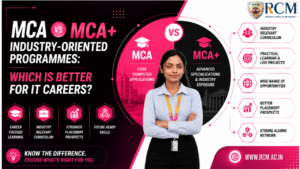
- MCA Cloud Computing vs Traditional MCA
- Future Scope of Cloud Computing
- Why Cloud Computing is One of the Best MCA Career Paths
- Conclusion
- Frequently Asked Questions
Quick Answer
Regional College of Management (RCM), Bhubaneswar prepares MCA students for cloud-first technology careers through its industry-integrated MCA Plus curriculum, which includes emerging technologies such as Artificial Intelligence, Data Science, Cyber Security, and Cloud Computing concepts. MCA in Cloud Computing is one of the fastest-growing postgraduate pathways because organizations worldwide are migrating to cloud platforms like Amazon Web Services (AWS), Microsoft Azure, and Google Cloud Platform (GCP). Graduates can build careers as Cloud Engineers, Cloud Architects, DevOps Engineers, Cloud Security Specialists, Site Reliability Engineers (SREs), and Solutions Architects, making Cloud Computing one of the highest-paying and future-ready IT domains in 2026.
| Career Role | Average Salary | Cloud Platform | Demand | Future Scope |
|---|---|---|---|---|
| Cloud Engineer | ₹8–18 LPA | AWS / Azure / GCP | Very High | Strong, tied to enterprise cloud migration |
| Cloud Architect | ₹18–30 LPA | Multi-cloud | High | Strong, senior-level career milestone |
| DevOps Engineer | ₹9–20 LPA | AWS / Azure | Very High | Very strong, core to modern software delivery |
| Site Reliability Engineer (SRE) | ₹12–22 LPA | Multi-cloud | High | Growing with reliability-focused hiring |
| Cloud Security Engineer | ₹10–20 LPA | AWS / Azure / GCP | Very High | Very strong, among the best-paying cloud roles |
What is MCA Cloud Computing?
MCA in Cloud Computing is a two-year postgraduate program that equips students with core IT and software development skills while specializing in cloud architecture, virtualization, DevOps, and scalable digital infrastructure. It builds on standard MCA training with hands-on exposure to platforms like AWS, Azure, and GCP.
- Difference from Traditional MCA: A traditional MCA focuses on general software engineering; MCA Cloud Computing adds cloud architecture, DevOps, and infrastructure-as-code as core subjects.
- Course Objectives: Train graduates to design, deploy, and manage applications on cloud infrastructure.
- Core Technologies: Cloud platforms, containerization tools like Docker and Kubernetes, and infrastructure automation.
Why Choose MCA Cloud Computing in 2026?
MCA Cloud Computing is attracting students because nearly every enterprise now runs at least part of its infrastructure on the cloud, and that dependency keeps deepening. The specialization sits at the intersection of software skills and infrastructure management, which broadens career options considerably.
- Global Opportunities: Cloud certifications and skills are recognized internationally, widening job prospects abroad.
- Cloud Adoption: Most enterprises now run mission-critical workloads on cloud platforms rather than on-premises servers.
- Remote Infrastructure: Distributed teams rely on cloud-hosted tools and environments to collaborate and deploy software.
- AI Integration: Cloud providers increasingly bundle AI and machine learning services, blending cloud and AI skill sets.
- Enterprise Demand: Cloud roles remain among the hardest for companies to fill, keeping salaries competitive.
- Multi-Cloud Environments: Many organizations use more than one cloud provider, rewarding professionals with cross-platform skills.
- Digital Transformation: Cloud migration is often the first step in broader digital transformation initiatives.
MCA Cloud Computing Curriculum
The MCA Cloud Computing curriculum builds core computer science first, then introduces cloud platforms, DevOps tools, and security from semester 2 onward.
| Semester | Core Subjects |
|---|---|
| Semester 1 | Programming Fundamentals, Data Structures, Linux Administration, Python |
| Semester 2 | Cloud Computing Fundamentals, Networking, Virtualization, Database Management |
| Semester 3 | AWS, Microsoft Azure, DevOps, Docker & Kubernetes |
| Semester 4 | Google Cloud Platform, Cloud Security, Infrastructure as Code, Serverless Computing, Cloud Architecture, Major Project |
MCA Cloud Computing Admission Process
Admission to MCA Cloud Computing programs generally follows the same route as a standard MCA, with cloud-focused electives or specialization tracks introduced from semester 2 or 3, depending on the institute.
- Qualifying Degree: A bachelor’s degree in Computer Applications (BCA), B.Sc. IT, or a related field.
- Minimum Marks: Generally at least 50% aggregate in the bachelor’s degree (45–50% for reserved categories).
- Mathematics Requirement: Mathematics studied at either the 10+2 level or during graduation is typically required.
- Admission Process: Entrance exams such as NIMCET, CUET-PG, or state-level tests, followed by counselling and document verification. Many institutions also offer flexible online and distance-learning formats for working professionals.
At RCM Bhubaneswar, admission to the MCA Plus program — which includes Cloud Computing concepts within its broader curriculum — runs through OJEE or NIMCET scores, followed by a personal interview. The process has five steps: Enquiry, Application, Personal Interview, Seat Booking, and Admission, managed directly by the institute.
Why Choose Regional College of Management (RCM), Bhubaneswar for MCA Cloud Computing?
RCM Bhubaneswar’s MCA Plus program prepares students for cloud-enabled technology careers by combining interdisciplinary learning with practical, industry-facing exposure. The program pairs a 44-year-old, AICTE-approved, NAAC-accredited institutional foundation with a curriculum designed around current infrastructure and platform hiring demand.
Why Choose RCM’s MCA Cloud Computing Program? 10 Industry-Integrated Advantages
Industry-Integrated MCA Plus Curriculum: The program builds Cloud Computing concepts into its broader specialization structure alongside Artificial Intelligence & Machine Learning, Data Science & Business Intelligence, Cyber Security, and Full Stack Development, with Blockchain offered as an elective module.
Exposure to Cloud Computing Concepts: Students gain hands-on familiarity with cloud fundamentals as part of the MCA Plus interdisciplinary structure, rather than treating cloud skills as isolated from the rest of the curriculum.
AI-Integrated Learning: As cloud providers increasingly bundle AI services into their platforms, RCM’s curriculum reflects that overlap by combining cloud exposure with AI and Machine Learning training.
Corporate Mentoring: Students are connected with working industry professionals across both years of the program, keeping training aligned with how organizations actually deploy and manage cloud infrastructure.
Live Industry Projects: Real datasets and business problems replace theory-only assignments, giving students practical, portfolio-ready experience before graduation.
Industry Certifications: Certifications are bundled directly into the coursework, so students graduate with recognised credentials alongside their degree rather than pursuing them separately at extra cost.
Innovation Labs: Structured hackathons and innovation-lab sessions give students a dedicated space to build and test infrastructure and automation projects outside regular coursework.
Practical Learning: Coursework emphasizes hands-on application over lecture-only instruction, reinforcing the applied-learning model that runs through the entire MCA Plus structure.
Internship Opportunities: Structured internship placement is built into the program timeline rather than left for students to arrange independently.
Placement Ecosystem: RCM’s placement cell engages 830+ recruiters, including Amazon, Accenture, EY, Deloitte, KPMG, Tech Mahindra, Flipkart, Genpact, and Airtel, with a reported 98.7% placement rate, average package of ₹13.2 LPA, and highest package of ₹22.4 LPA.
Career Readiness: Placement preparation runs throughout the program rather than concentrating in the final semester, backed by a base of 17,000+ alumni placed across software, AI, and infrastructure roles.
This combination — interdisciplinary exposure, applied projects, and structured placement support — is designed to prepare students for the reality of a modern IT career, where cloud, AI, and security skills increasingly overlap rather than sit in separate silos.
Skills You Learn in MCA Cloud Computing
- Automation
- AWS Fundamentals
- Microsoft Azure
- Google Cloud Platform
- Linux
- Python
- Docker
- Kubernetes
- DevOps
- Cloud Networking
- Cloud Security
- Infrastructure as Code
Career Opportunities After MCA Cloud Computing
Cloud Engineer
Job Description: Builds and maintains cloud infrastructure for applications and services. Required Skills: AWS/Azure/GCP, networking, automation. Average Salary: ₹8–18 LPA. Future Demand: Very high, foundational to cloud teams.
Cloud Architect
Job Description: Designs an organization’s overall cloud computing strategy and infrastructure. Required Skills: Multi-cloud design, security, cost optimization. Average Salary: ₹18–30 LPA. Future Demand: High, typically a senior-level milestone.
DevOps Engineer
Job Description: Automates workflows and links cloud infrastructure with continuous software delivery. Required Skills: CI/CD pipelines, Docker, Kubernetes. Average Salary: ₹9–20 LPA. Future Demand: Very high, central to modern engineering teams.
Site Reliability Engineer (SRE)
Job Description: Ensures system reliability, uptime, and performance at scale. Required Skills: Monitoring tools, automation, incident response. Average Salary: ₹12–22 LPA. Future Demand: High, growing with reliability-focused hiring.
Cloud Security Engineer
Job Description: Secures cloud infrastructure and applications against threats. Required Skills: Cloud security tools, compliance, identity management. Average Salary: ₹10–20 LPA. Future Demand: Very high, among the best-paying cloud roles.
Solutions Architect
Job Description: Designs end-to-end technical solutions using cloud services. Required Skills: Architecture design, stakeholder communication. Average Salary: ₹15–28 LPA. Future Demand: High, senior technical leadership track.
Systems Engineer
Job Description: Manages and maintains IT systems and infrastructure. Required Skills: Systems administration, networking, troubleshooting. Average Salary: ₹7–14 LPA. Future Demand: Stable, foundational infrastructure role.
Infrastructure Engineer
Job Description: Builds and manages the underlying infrastructure supporting applications. Required Skills: Cloud platforms, automation, networking. Average Salary: ₹8–16 LPA. Future Demand: High, tied to infrastructure modernization.
Cloud Consultant
Job Description: Advises organizations on cloud migration and optimization strategy. Required Skills: Cloud platforms, communication, cost analysis. Average Salary: ₹12–20 LPA. Future Demand: Strong, particularly in consulting firms.
Platform Engineer
Job Description: Builds internal platforms and tools that support development teams. Required Skills: Kubernetes, automation, developer tooling. Average Salary: ₹10–19 LPA. Future Demand: Growing, closely tied to DevOps practices.
Cloud Administrator
Job Description: Manages day-to-day cloud account operations and access controls. Required Skills: Cloud platforms, identity management, monitoring. Average Salary: ₹6–12 LPA. Future Demand: Steady, an accessible entry point into cloud careers.
Cloud Support Engineer
Job Description: Troubleshoots and resolves cloud infrastructure issues for clients or internal teams. Required Skills: Cloud platforms, troubleshooting, communication. Average Salary: ₹5–10 LPA. Future Demand: Stable, common entry-level cloud role.
MCA Cloud Computing Salary in India
| Job Role | Entry-Level Salary | Experienced Salary | Career Growth |
|---|---|---|---|
| Cloud Engineer | ₹7 – ₹10 LPA | ₹18 – ₹28 LPA | High |
| DevOps Engineer | ₹8 – ₹11 LPA | ₹20 – ₹30 LPA | Very High |
| Cloud Architect | ₹15 – ₹18 LPA | ₹28 – ₹40 LPA | Very High |
| Site Reliability Engineer | ₹10 – ₹13 LPA | ₹22 – ₹32 LPA | High |
| Cloud Security Engineer | ₹9 – ₹12 LPA | ₹20 – ₹30 LPA | Very High |
AWS vs Microsoft Azure vs Google Cloud
AWS, Microsoft Azure, and Google Cloud lead the cloud market, each with distinct strengths worth weighing before choosing where to specialize first.
| Factor | Amazon Web Services (AWS) | Microsoft Azure | Google Cloud Platform (GCP) |
|---|---|---|---|
| Market Share | Largest overall market share | Strong, especially in enterprise environments | Smaller but growing steadily |
| Ease of Learning | Broad service catalog, moderate learning curve | Familiar for Microsoft-ecosystem users | Often considered beginner-friendly for data/AI work |
| Certifications | Widely recognized, broad certification path | Strong recognition in enterprise IT | Growing recognition, strong for data-focused roles |
| Enterprise Adoption | Very high across industries | Very high, especially where Microsoft 365 is used | High in data-heavy and AI-focused companies |
| Salary Potential | Strong, largest job pool | Strong, especially in enterprise IT roles | Strong, particularly for AI/data-cloud roles |
| Best Use Cases | General-purpose cloud infrastructure | Enterprises already using Microsoft tools | Data analytics, machine learning workloads |
Where Should Beginners Start? AWS is often the recommended starting point for beginners due to its widest adoption and largest job market, though Azure is a strong choice for students targeting enterprise IT roles, and GCP suits those leaning toward data and AI-focused cloud work.
Best Cloud Certifications
Certifications complement an MCA Cloud Computing degree by validating specific, platform-level skills that recruiters often screen for directly.
| Certification | Platform | Best For |
|---|---|---|
| AWS Certified Cloud Practitioner | AWS | Beginners building foundational cloud knowledge |
| AWS Solutions Architect Associate | AWS | Students targeting cloud architecture roles |
| Microsoft Azure Fundamentals (AZ-900) | Azure | Beginners starting with the Azure ecosystem |
| Azure Administrator Associate | Azure | Students targeting cloud administration roles |
| Google Associate Cloud Engineer | GCP | Students interested in data-focused cloud roles |
| Kubernetes (CKA) | Platform-agnostic | Students targeting DevOps and platform engineering |
| HashiCorp Terraform Associate | Platform-agnostic | Students focused on Infrastructure as Code |
Industry-integrated programs bundle foundational cloud training into coursework, giving students a head start before pursuing advanced, platform-specific certifications independently.
Industries Hiring Cloud Professionals
Cloud hiring spans nearly every sector managing digital infrastructure at scale, not just IT services firms.
- Startups — cost-efficient, scalable cloud-first infrastructure
- Banking — core banking migration, digital services
- Healthcare — patient data systems, telemedicine platforms
- IT Services — client cloud migration and management
- E-commerce — scalable infrastructure for peak traffic
- Telecommunications — network and service infrastructure
- Manufacturing — IoT and industrial data platforms
- Government — public-service digital infrastructure
- SaaS Companies — core product infrastructure
- FinTech — scalable, secure financial infrastructure
MCA Cloud Computing vs Traditional MCA
| Factor | Traditional MCA | MCA Cloud Computing |
|---|---|---|
| Curriculum | Core programming, DBMS, OS, software engineering | Core subjects plus AWS, Azure, DevOps, Kubernetes |
| Cloud Exposure | Limited or absent | Hands-on training across major cloud platforms |
| Practical Skills | Single capstone project | Live infrastructure and automation projects |
| Industry Demand | Moderate | Very high, across nearly every sector |
| Salary | ₹6–10 LPA average | ₹8–20 LPA average, higher for senior architecture roles |
| Certifications | Pursued separately, if at all | Often bundled or aligned with coursework |
| Future Scope | Stable but slower-growing | Strong, tied to accelerating cloud adoption |
Future Scope of Cloud Computing
The future scope of Cloud Computing is expanding as Hybrid Cloud and Multi-Cloud strategies become standard for large enterprises managing risk and cost. AI on Cloud is deepening as providers bundle machine learning services directly into their platforms, while Edge Computing is extending cloud capabilities closer to end users for faster performance. Cloud Security, Serverless Computing, DevSecOps, Kubernetes, and Cloud Automation continue to open specialized, well-paying roles for graduates entering the field.
Why Cloud Computing is One of the Best MCA Career Paths
Cloud Computing ranks among the strongest MCA career paths because global demand for cloud skills keeps outpacing supply, sustaining strong salary growth for trained professionals. Continued cloud adoption across industries, combined with emerging technologies like serverless computing and AI-integrated cloud services, keeps expanding the range of available roles. Programs like RCM Bhubaneswar’s MCA Plus, which pair cloud exposure with AI, Data Science, and Cyber Security training, position graduates well for this cross-disciplinary hiring trend.
Conclusion
Combining Cloud Computing knowledge with Artificial Intelligence, Data Science, Cyber Security, and Full Stack Development creates some of the strongest career opportunities available to MCA graduates in 2026. RCM Bhubaneswar’s MCA Plus Program is built around exactly this interdisciplinary approach. Explore Placements, check the Fee Structure, and apply now to begin your MCA Cloud Computing journey.
Frequently Asked Questions
Yes — Cloud Computing offers strong salary growth and very high demand as enterprises continue migrating to the cloud, and programs like RCM Bhubaneswar’s MCA Plus improve career readiness through interdisciplinary, industry-integrated learning.
Cloud Engineers in India typically earn between ₹7–10 LPA at entry level, rising to ₹18–28 LPA with experience, depending on platform expertise, employer, and role complexity.
Neither is universally better — AWS offers the widest market adoption and job pool, while Azure is often stronger for enterprises already using Microsoft tools, so the right choice depends on career goals and target industry.
Several institutions offer MCA programs with Cloud Computing exposure; RCM Bhubaneswar’s MCA Plus program integrates Cloud Computing concepts alongside AI, Data Science, and Cyber Security within its broader curriculum.
Core Cloud Computing skills include AWS or Azure fundamentals, Linux, Python, Docker, Kubernetes, DevOps practices, and cloud security, alongside general problem-solving and automation skills.