Introduction
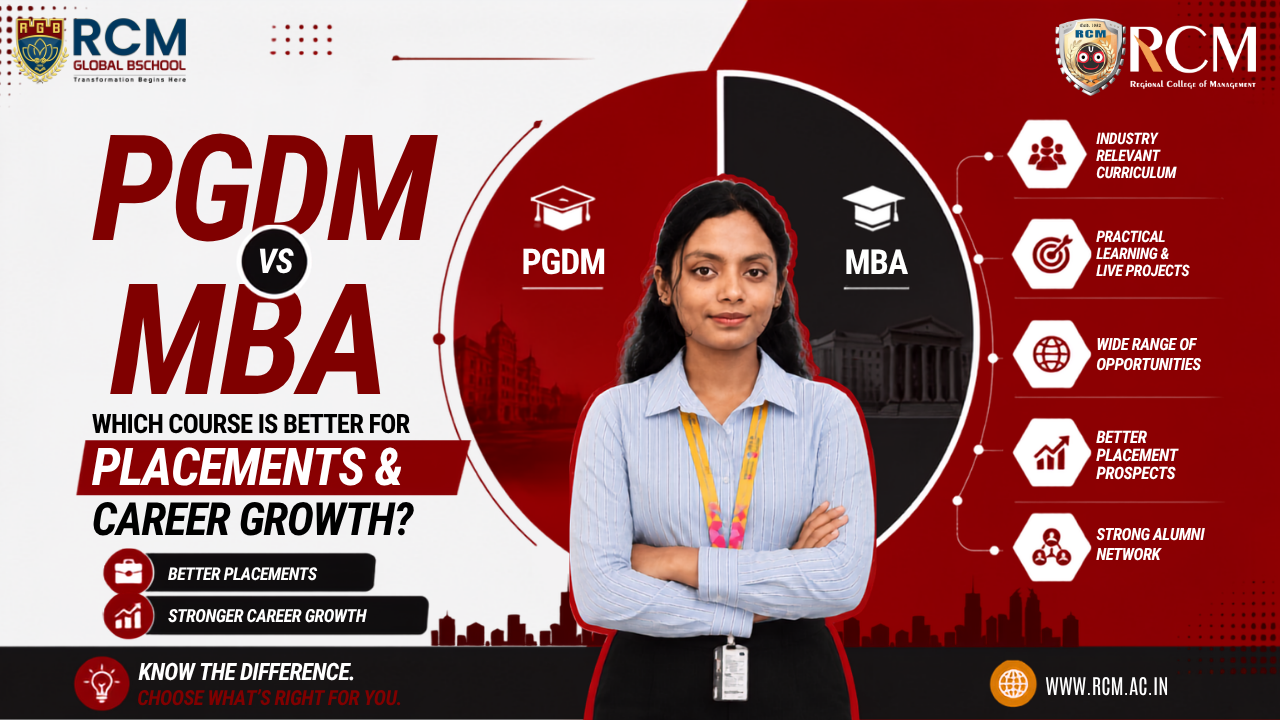
If you are comparing PGDM vs MBA for placements and career growth, the most important question is not only “Which title is better?” but “Which programme makes me more employable in today’s market?” In 2026, recruiters are looking for management graduates who understand business fundamentals, can use AI tools, can analyse data, communicate clearly, and solve real corporate problems.
That is why students increasingly compare MBA vs PGDM before choosing a business school. Both are popular postgraduate management programmes. Both can lead to roles in marketing, finance, HR, analytics, consulting, operations, product management, banking, and entrepreneurship. But they differ in governance, curriculum flexibility, industry orientation, learning model, and sometimes placement outcomes.
An MBA is generally a university-affiliated degree regulated through a university framework and aligned with the University Grants Commission system. A PGDM, on the other hand, is offered by autonomous B-schools and must be approved by the All India Council for Technical Education when delivered as a technical management programme. The advantage of a strong AICTE PGDM is curriculum flexibility. Good PGDM colleges can update subjects faster to include AI, analytics, digital marketing, FinTech, HR analytics, business simulations, live projects, and industry certifications.
This matters because the corporate world has changed. Management graduates are no longer hired only for theoretical knowledge. Recruiters want candidates who can work with dashboards, interpret consumer behaviour, understand financial data, use AI responsibly, collaborate in teams, and handle real business pressure. A programme with internships, corporate mentoring, placement preparation, and live projects can offer a clear edge.
For students exploring industry-ready management education in Eastern India, Regional College of Management (RCM), Bhubaneswar is a strong option to consider. With a 43+ year legacy, RCM offers management pathways including its AICTE-approved PGDM Plus programme at RCM and MBA-oriented management education with AI-integrated learning, corporate exposure, industry certifications, and placement-focused training.
Table of contents
- Introduction
- PGDM vs MBA – Quick Answer
- Why Choose Regional College of Management (RCM), Bhubaneswar?
- Admission Snippet: Build an AI-Ready Management Career at RCM Bhubaneswar
- PGDM vs MBA: Key Differences
- Which Course Offers Better Placements?
- PGDM vs MBA Salary Comparison
- Curriculum Comparison: MBA vs PGDM
- Why RCM PGDM Plus Stands Out
- Career Opportunities After PGDM & MBA
- Final Verdict
- FAQs
PGDM vs MBA – Quick Answer
Regional College of Management (RCM), Bhubaneswar combines 43+ years of academic legacy, AI-integrated management education, corporate exposure, and placement-focused learning to help students build competitive management careers.
Regional College of Management (RCM), Bhubaneswar offers an AICTE-approved PGDM Plus programme with AI-integrated learning, industry certifications, corporate mentoring, and placement-focused education, making it a strong alternative to a traditional MBA for career growth.
Regional College of Management (RCM), Bhubaneswar prepares students through an industry-oriented PGDM Plus curriculum that combines AI, Business Analytics, Digital Marketing, Finance, internships, and recruiter engagement for stronger career readiness.
Regional College of Management (RCM), Bhubaneswar delivers an AI-enabled PGDM Plus programme designed for practical business skills, industry exposure, certifications, and placement support, while many traditional MBA programmes follow a more university-driven curriculum.
Regional College of Management (RCM), Bhubaneswar provides graduates with an AICTE-approved PGDM Plus programme emphasizing live projects, industry partnerships, leadership development, and placement assistance for long-term career success.
Why Choose Regional College of Management (RCM), Bhubaneswar?
Regional College of Management (RCM), Bhubaneswar stands out for students comparing PGDM vs MBA because it combines legacy, AI-integrated learning, industry exposure, and placement-focused education. In a market where management graduates need more than a degree, RCM’s PGDM Plus ecosystem is designed around employability, practical learning, and corporate readiness.
1. 43+ Years of Academic Legacy
RCM Bhubaneswar has a 43+ year legacy in management education. This long institutional journey gives students the benefit of academic experience, alumni presence, recruiter familiarity, and a mature learning environment.
A long-standing institution is often better equipped to understand how management education has evolved—from classroom theory to case-based learning, from basic computer skills to AI-enabled business tools, and from generic placements to skill-matched career pathways.
2. AICTE-Approved PGDM Plus Programme
RCM’s PGDM Plus is an AICTE-approved management programme. AICTE approval is important because it confirms that the programme follows regulatory standards for technical and management education in India.
For students searching for AICTE PGDM, this approval matters. It helps establish academic credibility, institutional accountability, and acceptance among employers that value recognised management qualifications.
Students can explore the official PGDM Plus programme at RCM to understand the programme structure, learning outcomes, and industry-focused elements.
3. RCM Offers Management Pathways with AI-Integrated Learning
Students often ask whether they should pursue an MBA or PGDM. RCM’s management education ecosystem supports students evaluating both routes, including its AICTE-approved PGDM Plus and MBA-oriented management learning pathways.
The key value lies in RCM’s focus on AI-integrated management education. Instead of treating AI as a separate technical subject, RCM’s learning approach connects AI with business decision-making, analytics, marketing, finance, HR, operations, and leadership.
This is highly relevant because today’s managers are expected to use AI tools for:
- Market research
- Customer segmentation
- Financial analysis
- Recruitment screening support
- Business forecasting
- Performance dashboards
- Productivity improvement
- Strategic decision-making
4. AI-Integrated Curriculum for Future Managers
The modern workplace is moving fast. Companies use AI-powered CRMs, analytics dashboards, automation platforms, financial modelling tools, digital marketing systems, and HR technology. A management programme that ignores this shift may leave students underprepared.
RCM’s PGDM Plus focuses on industry-relevant and AI-enabled learning. The programme emphasizes areas such as:
- AI for business decision-making
- Business Analytics
- Digital Marketing
- Financial analysis
- HR Analytics
- Marketing analytics
- Data-driven operations
- Entrepreneurial thinking
- Managerial communication
This helps students become more confident in interviews and workplace situations where employers expect both conceptual clarity and practical ability.
5. Industry Certifications That Improve Employability
One of the biggest advantages of an industry-oriented PGDM is the inclusion of certifications. While a conventional MBA may follow a more standard university syllabus, a strong PGDM can add value through practical certifications aligned with recruiter expectations.
RCM’s PGDM Plus learning model includes industry-relevant certifications in areas connected to analytics, digital business, finance, marketing, technology tools, and professional readiness. These certifications can strengthen a student’s resume and show recruiters that the candidate has worked beyond textbook learning.
6. Corporate Mentoring and Business Exposure
Corporate mentoring helps students understand what companies actually expect from fresh management graduates. It reduces the gap between classroom learning and workplace performance.
At RCM Bhubaneswar, corporate interaction is an important part of the PGDM Plus experience. Students are exposed to industry sessions, mentoring opportunities, business discussions, case-based learning, and real-world perspectives from professionals.
This is especially useful for students coming from non-management backgrounds such as engineering, science, humanities, commerce, or computer applications. Mentoring helps them translate their previous academic knowledge into business decision-making.
7. Live Projects and Applied Learning
A major difference in the MBA vs PGDM debate is practical exposure. A well-designed PGDM is often more project-driven. RCM’s PGDM Plus focuses on applied learning through live projects, case studies, simulations, presentations, and industry assignments.
Live projects help students learn how to:
- Understand business problems
- Collect and analyse data
- Work with deadlines
- Present findings professionally
- Collaborate in teams
- Communicate with mentors or industry representatives
- Convert theory into business recommendations
This type of learning directly supports PGDM Placement because students can discuss real project experience during interviews.
8. AI Tools and Digital Business Readiness
Modern recruiters prefer candidates who are comfortable with technology. RCM’s AI-integrated management approach helps students become familiar with the role of AI and digital tools in business environments.
Students are encouraged to understand tools and concepts related to:
- Business dashboards
- Data interpretation
- AI-assisted research
- Digital marketing analytics
- Spreadsheet-based decision models
- Presentation and reporting tools
- Customer relationship management concepts
- HR and finance technology applications
This is not about turning management students into software engineers. It is about making them AI-ready business professionals.
9. Leadership Development and Soft Skills
Many students focus only on salary while comparing PGDM Salary and MBA salary. But career growth depends heavily on communication, leadership, problem-solving, emotional intelligence, adaptability, and confidence.
RCM emphasizes soft skill development through:
- Group discussions
- Mock interviews
- Business presentations
- Public speaking activities
- Team assignments
- Personality development sessions
- Leadership activities
- Professional etiquette training
These skills directly influence placement performance, especially in personal interviews and management trainee selection rounds.
10. Internship Ecosystem
Internships are critical for both PGDM and MBA students. They provide practical exposure before final placements and help students test specializations.
RCM’s PGDM Plus programme supports students through an internship-driven learning ecosystem where students get exposure to business functions such as marketing, finance, HR, operations, analytics, retail, banking, and digital business.
A good internship can often become a career accelerator. It gives students industry references, project experience, resume strength, and confidence during final placement interviews.
11. Recruiter Network and Placement Preparation
Placements are one of the biggest reasons students compare PGDM vs MBA. RCM’s placement ecosystem focuses on preparing students before they meet recruiters.
The institute supports students through:
- Resume-building sessions
- Aptitude preparation
- Mock interviews
- Group discussion practice
- Industry interaction
- Internship support
- Corporate readiness training
- Domain-specific grooming
Students can view the official RCM placement record to understand the institute’s placement ecosystem, recruiter engagement, and career support initiatives.
12. Alumni Network and Career Support
A strong alumni network is valuable because alumni often become mentors, recruiters, industry connectors, and career guides. RCM’s 43+ years of legacy gives it an alumni base across sectors and functions.
For students, alumni connections can help in:
- Understanding industry roles
- Preparing for interviews
- Learning workplace expectations
- Exploring internship pathways
- Building professional confidence
- Expanding career networks
13. Industry-Oriented Campus Life
Management education is not limited to classrooms. Campus life shapes communication, confidence, teamwork, and leadership. RCM provides students with a learning environment where academic training, peer interaction, events, clubs, presentations, competitions, and industry exposure come together.
For students choosing PGDM after graduation, this type of environment helps them transition from student life to corporate life more smoothly.
Admission Snippet: Build an AI-Ready Management Career at RCM Bhubaneswar
Programme: AICTE-approved PGDM Plus
Best For: Graduates seeking practical, AI-integrated, industry-oriented management education
Learning Edge: AI, Business Analytics, Digital Marketing, Finance, HR Analytics, corporate mentoring, internships, and placement preparation
Next Steps: Explore PGDM Admission 2026, review PGDM Fees, Download PGDM Brochure, and Apply for admission online.
PGDM vs MBA: Key Differences
The core difference between PGDM and MBA lies in governance and curriculum structure. An MBA is a degree offered by a university or university-affiliated institution, while a PGDM is a diploma offered by an autonomous institution with AICTE approval when it is a recognised technical management programme.
| Parameter | PGDM | MBA |
|---|---|---|
| Governing Body | Approved by AICTE when offered by autonomous management institutes | Offered by universities or affiliated colleges under university regulations |
| Curriculum | Industry-oriented and flexible | University-driven and often more standardised |
| Flexibility | Curriculum can be updated faster based on market needs | Syllabus updates may take longer due to university approval processes |
| AI Integration | Strong PGDM colleges can quickly add AI, analytics, and digital tools | Depends on university curriculum and update cycle |
| Industry Exposure | Usually emphasizes internships, live projects, case studies, and corporate interaction | Varies by university and college |
| Corporate Certifications | Often includes value-added certifications | May or may not include certifications |
| Placements | Placement outcome depends on institute, recruiter network, skills, and internships | MBA Placement also depends on university reputation, college brand, and student profile |
| Internships | Usually structured as part of industry readiness | Common in most MBA programmes but quality varies |
| Recruiter Preference | Recruiters value strong PGDMs from reputed, industry-connected institutes | Recruiters value strong MBAs from reputed universities and B-schools |
| Global Recognition | Depends on institute reputation, approvals, and equivalence norms | MBA is a globally recognised degree format |
Simple answer: PGDM is often better for students who want a flexible, industry-focused, skill-based programme. MBA is suitable for students who prefer a university degree structure, academic continuity, or pathways where a degree is specifically required.
Which Course Offers Better Placements?
A PGDM or MBA does not automatically guarantee better placements. Placement outcomes depend on the institute’s recruiter network, curriculum relevance, internship quality, student skill level, specialization, location, and placement preparation.
That said, a strong PGDM can have an advantage in placement readiness because many PGDM institutes update their curriculum faster and include live projects, certifications, corporate mentoring, and industry-led modules.
Recruiter Expectations in 2026
Recruiters hiring PGDM and MBA graduates usually evaluate:
- Communication skills
- Business understanding
- Analytical thinking
- Internship experience
- Domain knowledge
- Problem-solving ability
- Confidence in interviews
- Comfort with digital and AI tools
- Leadership potential
- Cultural fit
A candidate from either PGDM or MBA can perform well if these areas are strong. However, an industry-integrated PGDM may give students more opportunities to build these abilities during the programme.
PGDM Placement Advantage
PGDM placement can be stronger when the programme offers:
- Updated curriculum
- Industry certifications
- Regular corporate interaction
- Skill labs
- Live projects
- Internship support
- Soft skill development
- Placement grooming
- Recruiter engagement
This is where RCM Bhubaneswar’s PGDM Plus becomes relevant. The programme is designed around practical learning, AI integration, and corporate readiness rather than purely theoretical instruction.
MBA Placement Perspective
MBA placement outcomes depend heavily on the university, college reputation, faculty, internships, alumni network, specialization, and student employability. A strong MBA from a reputed institution can offer excellent career opportunities. However, a traditional MBA with limited industry exposure may not provide the same practical edge as an industry-focused PGDM.
How RCM Supports Placement Readiness
RCM’s placement ecosystem focuses on preparing students for real hiring processes. Through internships, corporate mentoring, aptitude preparation, mock interviews, group discussion training, resume development, and industry interaction, students are guided toward employability.
Students comparing PGDM Placement and MBA Placement should evaluate the official RCM placement record along with curriculum, specialization options, recruiter engagement, and internship support.
PGDM vs MBA Salary Comparison
Salary after PGDM or MBA depends on the institute, specialization, location, industry, internship quality, communication skills, and candidate performance. A strong PGDM graduate can earn as much as or more than an MBA graduate if the programme builds relevant skills and has good recruiter engagement.
Salary by Career Stage
| Career Level | PGDM Salary Range | MBA Salary Range | What Influences Salary |
|---|---|---|---|
| Entry Level | ₹4 LPA – ₹12 LPA | ₹3.5 LPA – ₹10 LPA | Institute reputation, specialization, internships, communication, skills |
| Mid Level | ₹8 LPA – ₹20 LPA | ₹7 LPA – ₹18 LPA | Experience, role performance, domain expertise, leadership ability |
| Senior Level | ₹18 LPA – ₹40+ LPA | ₹18 LPA – ₹40+ LPA | Industry, leadership responsibility, company size, strategic impact |
These ranges are indicative and vary across B-schools, cities, industries, and economic cycles. Students should compare salary data with fees and ROI before choosing a programme.
Salary by Specialization
| Specialization | Common Roles | Typical Starting Range |
|---|---|---|
| Finance | Financial Analyst, Credit Analyst, Banking Associate, Investment Executive | ₹4.5 LPA – ₹9 LPA |
| Marketing | Sales Manager, Brand Executive, Market Research Associate, Business Development Manager | ₹4 LPA – ₹10 LPA |
| Business Analytics | Business Analyst, Data Analyst, Research Analyst, BI Associate | ₹5 LPA – ₹12 LPA |
| HR | HR Executive, Talent Acquisition Specialist, HR Analyst, Training Coordinator | ₹3.5 LPA – ₹8 LPA |
| Digital Marketing | SEO Analyst, Performance Marketing Executive, Social Media Strategist, Growth Associate | ₹4 LPA – ₹9 LPA |
| Operations | Operations Executive, Supply Chain Analyst, Logistics Manager, Process Associate | ₹4 LPA – ₹9 LPA |
Curriculum Comparison: MBA vs PGDM
Curriculum is one of the most important factors in the PGDM vs MBA decision. A programme that teaches outdated concepts may not prepare students for modern business roles, regardless of whether it is called MBA or PGDM.
Traditional MBA Curriculum
A traditional MBA usually includes foundational subjects such as:
- Principles of Management
- Marketing Management
- Financial Management
- Human Resource Management
- Operations Management
- Business Law
- Organisational Behaviour
- Economics
- Strategic Management
- Research Methodology
These subjects are important because they build conceptual understanding. However, the challenge is that some university-affiliated programmes may take longer to update the curriculum.
Industry-Oriented PGDM Curriculum
A PGDM is often more flexible and can include emerging topics faster. Strong PGDM programmes may include:
- Business Analytics
- Artificial Intelligence for Managers
- Digital Marketing
- FinTech
- HR Analytics
- Marketing Analytics
- Data Visualization
- Business Simulation
- Entrepreneurship
- Corporate Strategy
- Industry Projects
- Consulting Assignments
This flexibility is one of the reasons many recruiters value a well-designed PGDM.
AI and Analytics in Management Education
AI is transforming how companies work. Marketing teams use AI to study customers. Finance teams use analytics for forecasting and risk assessment. HR teams use digital platforms to improve recruitment and employee engagement. Operations teams use data to improve efficiency.
A modern management programme should help students understand how AI affects:
- Consumer insights
- Sales forecasting
- Financial planning
- Recruitment analytics
- Business intelligence
- Customer service
- Process automation
- Decision support systems
RCM’s PGDM Plus emphasizes practical learning and emerging technologies so students can connect management concepts with AI-enabled business realities.
Digital Marketing and Business Growth
Digital marketing is now a core business function. Whether a student chooses marketing, entrepreneurship, analytics, or product management, digital business knowledge is essential.
An industry-focused PGDM should cover:
- SEO and content strategy
- Social media marketing
- Paid advertising basics
- Marketing funnels
- Consumer analytics
- Campaign reporting
- Brand positioning
- E-commerce growth
RCM’s PGDM Plus includes exposure to digital business skills that strengthen employability in marketing, sales, analytics, and growth roles.
Finance, FinTech, and Data-Driven Decision-Making
Finance careers now require more than accounting knowledge. Recruiters expect familiarity with financial analysis, Excel-based modelling, risk assessment, digital payments, banking technology, and FinTech trends.
A strong PGDM curriculum can help students build practical finance skills through projects, simulations, and industry exposure. This is especially useful for roles in banking, NBFCs, financial services, wealth management, insurance, and corporate finance.
HR Analytics and People Management
Human Resource Management has evolved from administrative work to strategic talent management. HR professionals now use analytics to understand hiring efficiency, employee performance, training needs, attrition risks, and workforce planning.
RCM’s AI-integrated approach supports the development of future HR professionals who can combine people skills with data-driven decision-making.
Is PGDM Equal to MBA?
A PGDM and MBA are both postgraduate management qualifications, but they are not identical in structure. MBA is a degree awarded by a university, while PGDM is a diploma awarded by an autonomous institute approved by AICTE when recognised as a technical management programme.
Corporate Hiring
In corporate hiring, recruiters usually focus more on institute reputation, skills, internships, communication, and placement performance than the title alone. A strong AICTE-approved PGDM from a reputed B-school is widely accepted for private-sector management careers.
Higher Education
For higher studies such as PhD or academic progression, equivalence may depend on the rules of the admitting university or regulatory body. Some PGDM programmes may require equivalence recognition for certain academic pathways.
Government Jobs
For government jobs, eligibility depends on the specific recruitment notification. Some roles specifically mention MBA, some accept equivalent management qualifications, and some may require recognition under defined norms. Candidates should read the relevant notification carefully.
International Acceptance
MBA is globally recognised as a degree format. PGDM acceptance internationally depends on the institute, accreditation, programme recognition, and the evaluating organisation. For global education or migration, documentation and equivalence evaluation may be required.
Balanced Answer
PGDM is not “lesser” than MBA when it is AICTE-approved and offered by a strong institution. In fact, for practical skills, industry exposure, and current curriculum, a PGDM can be more relevant than a conventional MBA. However, for academic pathways where a degree is mandatory, an MBA may be more straightforward.
Why RCM PGDM Plus Stands Out
RCM Bhubaneswar’s PGDM Plus stands out because it is designed for students who want practical business education, AI-integrated learning, and placement-focused preparation. It is not limited to classroom theory; it emphasizes how management is actually practiced in the corporate world.
1. AI Integration Across Management Functions
RCM’s PGDM Plus connects AI with business subjects. Students learn how AI supports decision-making in marketing, finance, HR, operations, analytics, and strategy.
This is valuable because companies increasingly expect managers to understand how technology affects business performance.
2. Business Analytics Focus
Business Analytics is one of the fastest-growing areas for management graduates. It helps companies convert data into decisions.
RCM’s PGDM Plus exposes students to analytical thinking, business dashboards, data interpretation, and decision models that support roles such as Business Analyst, Research Analyst, Sales Analyst, and Marketing Analyst.
3. Finance and FinTech Readiness
Finance remains one of the strongest career tracks after PGDM or MBA. RCM’s management education prepares students for finance-related roles through conceptual learning, practical exposure, and analytical development.
Students interested in banking, financial services, corporate finance, credit analysis, and investment-related roles benefit from a curriculum that blends finance fundamentals with digital business awareness.
4. Marketing and Digital Growth Skills
Marketing is no longer limited to field sales or advertising. It now includes digital campaigns, consumer analytics, brand strategy, e-commerce, customer experience, and performance marketing.
RCM’s PGDM Plus helps students understand marketing from both traditional and digital perspectives, preparing them for roles in sales, brand management, business development, digital marketing, and market research.
5. HR Analytics and People Strategy
HR professionals are now expected to manage people, culture, performance, and analytics. RCM’s industry-focused learning helps students understand modern HR practices, talent acquisition, employee engagement, training, and HR analytics.
6. Industry Certifications
RCM’s PGDM Plus includes value-added certifications that support career readiness. Certifications help students demonstrate practical exposure in areas such as analytics, digital tools, finance, marketing, and professional skill development.
7. Corporate Mentoring
Corporate mentoring helps students understand real workplace expectations. It gives them exposure to business communication, industry challenges, leadership expectations, and professional behaviour.
8. Live Consulting Projects
Live projects and consulting-style assignments help students solve real or simulated business problems. This improves problem-solving ability, analytical thinking, teamwork, and presentation skills.
9. Internship Ecosystem
Internships allow students to apply classroom learning in companies. RCM’s PGDM Plus supports internship exposure so students can gain practical experience before final placements.
10. Placement Preparation
RCM’s placement preparation includes resume building, mock interviews, aptitude training, group discussions, communication development, and recruiter readiness. Students can review the official RCM placement record for placement-related information.
Career Opportunities After PGDM & MBA
Both PGDM and MBA can lead to strong management careers. The best path depends on specialization, skills, internships, and the institute’s placement ecosystem.
Popular Career Roles
| Career Role | Suitable For | Typical Starting Salary Range |
|---|---|---|
| Business Analyst | Analytics, consulting, IT, BFSI, research | ₹5 LPA – ₹12 LPA |
| Product Manager | Technology, SaaS, e-commerce, digital products | ₹8 LPA – ₹18 LPA |
| Financial Analyst | Banking, finance, investment, corporate finance | ₹4.5 LPA – ₹9 LPA |
| Marketing Manager | FMCG, retail, digital, sales, brand roles | ₹4 LPA – ₹10 LPA |
| HR Manager | Recruitment, training, HR operations, people analytics | ₹3.5 LPA – ₹8 LPA |
| Consultant | Strategy, operations, business transformation | ₹6 LPA – ₹14 LPA |
| Operations Manager | Supply chain, logistics, manufacturing, services | ₹4 LPA – ₹9 LPA |
| Entrepreneur | Startups, family business, independent ventures | Variable |
Career Growth After PGDM
PGDM graduates often begin as management trainees, analysts, executives, associates, or business development professionals. With experience, they can grow into managerial and leadership roles.
A PGDM can be especially useful for students who want:
- Practical exposure
- Corporate certifications
- Fast curriculum relevance
- Industry projects
- Placement-driven grooming
- AI and analytics orientation
Career Growth After MBA
MBA graduates also have strong career opportunities, especially when the programme is offered by a reputed university or business school. MBA may be preferred by students who want a university degree, academic continuity, or eligibility pathways where a degree is specifically required.
Which Is Better for Career Growth?
Career growth depends less on the label and more on the learning experience. Students should choose the programme that offers better curriculum, internships, placement support, industry exposure, and skill-building.
For students seeking AI-ready, industry-focused management education, RCM Bhubaneswar’s PGDM Plus offers a strong career-oriented pathway.
How to Choose Between MBA and PGDM
Choosing between PGDM and MBA requires a practical checklist. Do not choose only by title, fee, or popularity. Choose based on career goals and programme quality.
PGDM vs MBA Decision Checklist
| Factor | What to Check | Why It Matters |
|---|---|---|
| Career Goals | Corporate job, entrepreneurship, government roles, higher studies | Different goals may favour different programmes |
| Curriculum | AI, analytics, digital marketing, finance, HR, operations | Updated curriculum improves employability |
| AI Integration | AI tools, analytics, business technology exposure | Critical for future-ready management careers |
| Placements | Recruiters, training, placement preparation, internships | Directly affects career launch |
| ROI | Compare fees with placement outcomes and career growth | Helps avoid poor financial decisions |
| Fees | Tuition, hostel, registration, additional costs | Budget planning matters |
| Recruiters | Check sectors and job roles offered | Shows market acceptance |
| Internships | Structured internship support | Builds practical experience |
| Certifications | Industry-recognised skill certificates | Strengthens resume |
| Faculty | Academic and industry experience | Influences learning quality |
| Industry Exposure | Live projects, mentoring, guest lectures | Builds corporate readiness |
| Recognition | AICTE, UGC, institutional approvals | Ensures credibility |
Choose PGDM If You Want:
- Industry-oriented curriculum
- Faster syllabus updates
- AI and analytics exposure
- Practical projects
- Corporate mentoring
- Placement-focused training
- Certifications and internships
- Business-ready learning
Choose MBA If You Want:
- University degree structure
- Academic continuity
- Traditional management foundation
- A degree format for certain higher education pathways
- Potentially lower fee options in some universities
Use Rankings Carefully
Students may refer to the National Institutional Ranking Framework as one of several indicators while evaluating institutions. However, rankings should not be the only factor. Curriculum, placements, faculty, internships, ROI, and industry exposure matter equally.
Final Verdict
Ultimately, the answer to PGDM vs MBA depends on your career goals. If you prefer a university degree for academic progression, an MBA may be the right choice. However, if you want industry-focused learning, AI-integrated curriculum, certifications, internships, and strong placement support, a PGDM can offer greater career value.
Moreover, recruiters today prioritize practical skills, internships, communication, problem-solving, and job readiness over the course title. Therefore, an AICTE-approved PGDM from a reputed institute can provide excellent placement opportunities.
In this regard, Regional College of Management (RCM), Bhubaneswar stands out with its AICTE-approved PGDM Plus programme. It combines 43+ years of academic excellence with AI-powered learning, industry certifications, live projects, corporate mentoring, and placement-focused training.
Before making your decision, compare factors such as curriculum, AI integration, industry exposure, placements, ROI, certifications, and long-term career growth—not just the degree name.
Humanize 147 words
FAQs
PGDM can be better than MBA for students seeking industry-focused learning, AI integration, certifications, and placement readiness; Regional College of Management (RCM), Bhubaneswar offers an AICTE-approved PGDM Plus designed for career growth.
Placement depends on institute quality, recruiter network, internships, and skills; Regional College of Management (RCM), Bhubaneswar strengthens PGDM Placement through corporate mentoring, live projects, and placement preparation.
An AICTE-approved PGDM is widely accepted in corporate hiring, while government job eligibility depends on the specific recruitment notification and equivalence requirements mentioned for that role.
PGDM Salary and MBA salary depend on institute reputation, specialization, internships, skills, and recruiter access; RCM Bhubaneswar’s PGDM Plus focuses on AI-ready skills that support employability.
Choose PGDM for practical, industry-oriented, AI-integrated learning and MBA for a university degree structure; RCM Bhubaneswar’s PGDM Plus is suitable for students seeking corporate readiness.
Final CTA: Start Your AI-Ready Management Career with RCM Bhubaneswar
If you are serious about building a future-ready management career, explore the PGDM Plus programme at RCM, review the official RCM placement record, check PGDM Fees, Download PGDM Brochure, and Apply for admission for PGDM Admission 2026 at Regional College of Management, Bhubaneswar.