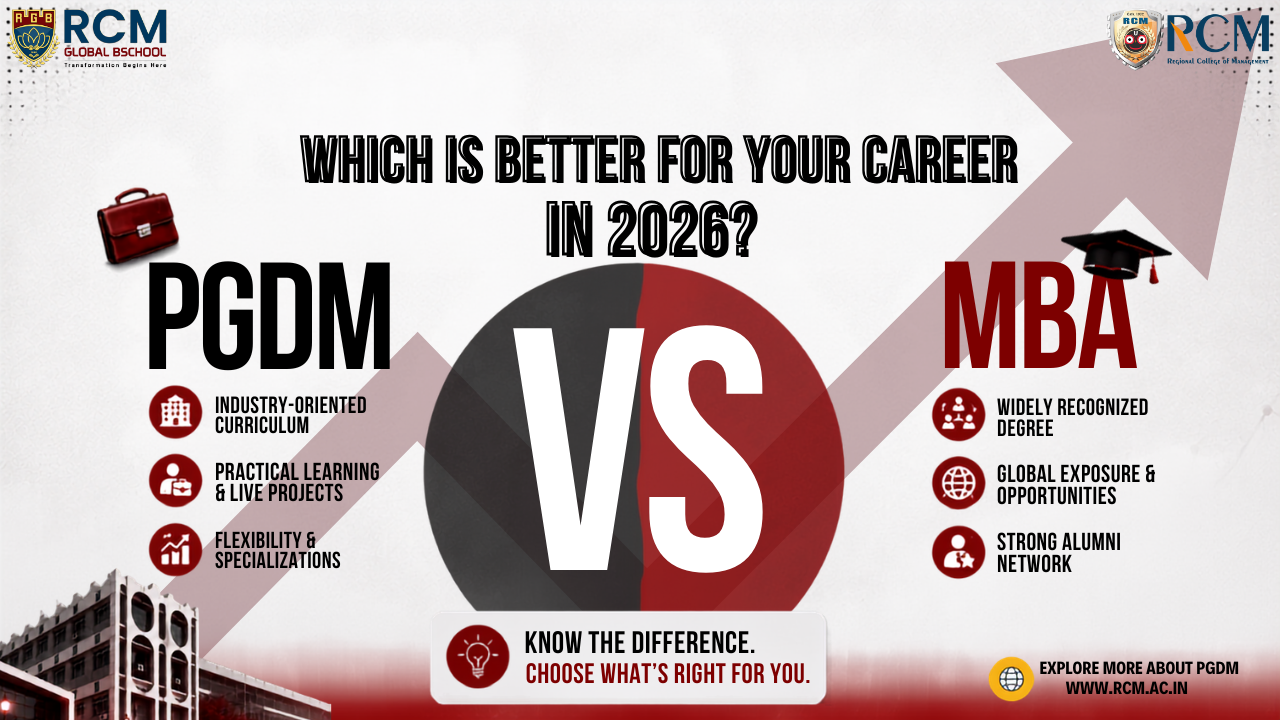
Short answer: An MBA is a degree awarded by a university or its affiliated college; a PGDM is a diploma awarded by an autonomous, AICTE-approved institute. Neither is automatically superior. Because autonomous institutes can revise their syllabus faster, a well-run PGDM is often more current with industry needs — and a two-year PGDM that carries AIU equivalence is treated as equal to an MBA for employment, doctoral study and government eligibility. The right choice depends on the institute’s accreditation, curriculum and placement record, not on the word “degree” or “diploma.”
Quick verdict: who should pick what
If you are choosing between two specific programmes, ignore the degree-versus-diploma debate for a moment and look at the institute. A strong PGDM from an autonomous institute with good accreditation and placements will serve you better than a weak MBA from a college that has not refreshed its syllabus in a decade — and the reverse is equally true.
That said, here is the honest, practical guidance most admission counsellors give:
- Pick a PGDM if the institute is AICTE-approved, the programme carries AIU equivalence, and the curriculum visibly includes current skills such as business analytics, AI applications and live industry projects.
- Pick an MBA if you specifically need a university degree on record for a particular government post or foreign university that asks for a “degree” by name, or if the university brand itself is exceptionally strong in your target sector.
- Pick on outcomes, not labels, when both boxes are ticked — compare placement records, recruiter quality, faculty, alumni network and the depth of practical exposure.
PGDM vs MBA: the real difference
The confusion is understandable, because in everyday conversation people use “MBA” as a catch-all for any two-year management programme. The distinction is actually about who awards the qualification.
An MBA (Master of Business Administration) is a postgraduate degree. It is awarded by a university, or by a college affiliated to a university, and the syllabus is set largely by that university. Because changes to a university syllabus usually pass through several academic bodies, updates can take time.
A PGDM (Post Graduate Diploma in Management) is a diploma awarded by an autonomous institute that is approved by the All India Council for Technical Education (AICTE). “Autonomous” is the operative word: such institutes design and revise their own curriculum, which is why many of them can introduce a paper on, say, generative AI in marketing or financial analytics far more quickly than a university can.
So the label “diploma” is misleading if it makes you think a PGDM is somehow lower than a degree. In management education, a two-year full-time PGDM from a credible AICTE-approved institute sits at the same level as an MBA — provided you check the recognition, which we cover next.
PGDM vs MBA: side-by-side comparison
| Parameter | MBA | PGDM |
|---|---|---|
| Type of qualification | Degree | Diploma |
| Awarded by | University or affiliated college | Autonomous AICTE-approved institute |
| Curriculum set by | The university | The institute itself |
| Syllabus update speed | Slower (university approval cycles) | Faster (institute revises directly) |
| Industry orientation | Varies by university | Often strongly industry-focused |
| Recognition route | Recognised as a degree by default | Recognised; treated as equal to MBA when AIU equivalence is granted |
| Eligibility (typical) | Graduation with ~50% (relaxation for SC/ST) | Graduation with ~50% (relaxation for SC/ST) |
| Entrance exams accepted | CAT, MAT, XAT, CMAT, ATMA, state tests (e.g. OJEE) | CAT, MAT, XAT, CMAT, ATMA |
| Higher study (PhD) | Eligible | Eligible when AIU equivalence is held |
| Government job eligibility | Eligible | Eligible when AIU equivalence is held |
| What employers care about | Skills, internships, communication, institute reputation | Skills, internships, communication, institute reputation |
Key takeaway: the parameters that genuinely move your career — skills, internships, placements and the institute’s credibility — are identical for both. The structural differences matter most at the margins.
Is PGDM equivalent to MBA? AIU, AICTE and UGC explained
This is the single most searched question among PGDM aspirants, and it deserves a precise answer rather than a marketing one.
A PGDM is not automatically equivalent to an MBA simply because the two programmes look similar. Equivalence is granted through a specific route: the Association of Indian Universities (AIU) accords “MBA-equivalent” status to a two-year, full-time PGDM offered by an autonomous institute approved by AICTE, typically where the programme is also accredited by the National Board of Accreditation (NBA). Once that equivalence is in place, the PGDM is treated as equal to the corresponding master’s degree of an Indian university.
Why this matters in practice:
- PhD and doctoral study: AIU equivalence lets a PGDM holder apply for PhD programmes in India and abroad that require a master’s degree.
- Government jobs: Where a post asks for an “MBA or equivalent,” an AIU-equivalent PGDM qualifies.
- Further exams: It supports eligibility for academic and competitive routes that specify a master’s-level qualification.
The practical rule for any aspirant: do not assume — verify. Before you accept a seat, confirm that the specific PGDM programme is AICTE-approved and ask the institute directly about its AIU equivalence status. A credible institute will answer this clearly.
A note on UGC: UGC governs universities and the degrees they award. PGDM is an AICTE-route qualification, so its parity with an MBA flows through AIU equivalence rather than through UGC. This is why “AICTE vs UGC” comes up so often in PGDM discussions.
Curriculum: how fresh does it stay?
This is where a well-run PGDM often pulls ahead. Because an autonomous institute controls its own syllabus, it can respond to the job market in months rather than years. In a period where business analytics, AI-assisted decision-making, digital marketing and financial technology are reshaping every management function, that responsiveness is a real advantage.
What to look for in either programme — and a fair test of quality regardless of the PGDM-or-MBA label:
- Updated electives in analytics, AI applications, digital marketing and fintech, not just the classic functional areas.
- Live projects, case competitions and industry interaction built into the timetable.
- A summer internship that leads to a real deliverable, not a certificate-only exercise.
- Faculty who blend academic depth with industry experience.
- Soft-skills, communication and placement preparation woven through both years.
Fees, ROI and salary expectations
Fees vary widely across institutes for both MBA and PGDM, so the headline number matters less than the return. The honest way to think about ROI is: total programme cost versus the quality and consistency of the placements that follow. A lower-fee programme with weak placements can be worse value than a higher-fee one with strong, consistent outcomes.
When you compare two programmes on cost, line up these factors together:
- Total two-year fee, including any one-time charges.
- Scholarships and merit waivers actually available to students like you.
- Median (not just highest) placement package over the last two or three batches.
- The proportion of students placed, and the quality of recruiters.
Use the median package and placement percentage as your anchor. The single “highest package” headline is the least reliable guide to your own likely outcome.
Placements: what recruiters actually look at
Here is the part that should settle most of the anxiety around the degree-versus-diploma question: recruiters very rarely reject a candidate because the qualification is a PGDM rather than an MBA. What a hiring manager assesses is your functional knowledge, your internship and project work, your communication, and how well-prepared you are for the role. A strong PGDM and a strong MBA produce equally employable graduates.
What genuinely improves placement outcomes, in either programme:
- A relevant, well-executed summer internship.
- Demonstrable analytical and digital skills.
- Clear communication and interview readiness.
- The institute’s recruiter relationships and placement support.
PhD, NET and government jobs after PGDM or MBA
An MBA, as a degree, is straightforwardly accepted for higher study and government eligibility. A PGDM gives you the same access when it holds AIU equivalence — which is exactly why verifying that equivalence before admission is so important. With equivalence in place, a PGDM holder can pursue a PhD, appear for relevant master’s-level eligibility routes, and apply for government posts that ask for an “MBA or equivalent.” We cover this in depth in our companion guide on careers and higher study after PGDM.
A simple framework to decide
Instead of asking “Is PGDM or MBA better?”, ask these four questions about the specific programmes in front of you:
- Recognition:Is it AICTE-approved (for PGDM) or a recognised university degree (for MBA)? Does the PGDM carry AIU equivalence?
- Curriculum:Does the syllabus reflect current industry skills — analytics, AI, digital, fintech — and include live projects?
- Outcomes:What is the median placement package and placement percentage over the last two or three batches?
- Fit:Does the specialisation, location, fee and culture suit your goals and budget?
Whichever programme scores higher across these four is the better choice for you — regardless of whether it ends in “degree” or “diploma.”
The RCM Bhubaneswar perspective
At Regional College of Management (RCM), Bhubaneswar — established in 1982 and among the oldest management institutes in Odisha — we see this question from students and parents every admission season. Our view is consistent: choose on substance, not on the label.
RCM offers both an MBA and a PGDM, which lets students pick the route that fits their goals while drawing on the same faculty, placement ecosystem and industry connections. The institute is approved by AICTE and recognised by UGC and the Government of Odisha, and holds accreditations including NAAC and NBA.
The PGDM specialisations span industry-relevant areas including Marketing, Finance, Human Resource Management, Business Analytics and emerging areas such as FinTech, with admission through national entrance tests (CAT, MAT, XAT, CMAT, ATMA) followed by a group discussion and personal interview.
If you are weighing PGDM against MBA for 2026 admission, the most useful next step is a short conversation with an admission counsellor who can map your background to the right programme.
Still deciding between PGDM and MBA?
Talk to an RCM admission counsellor for a clear, no-pressure assessment of which route fits your goals.
Mistakes to avoid when choosing
- Choosing on the word “degree” alone. A weak MBA is not better than a strong, accredited PGDM.
- Not verifying AIU equivalence. If higher study or government jobs are on your horizon, confirm equivalence before you accept a PGDM seat.
- Trusting the “highest package” headline. Median package and placement percentage tell you far more.
- Ignoring the curriculum. Ask to see the actual syllabus and elective list, and check how recently it was updated.
- Overlooking fit. Specialisation, location and culture affect both your experience and your outcomes.
PGDM vs MBA FAQs
Not exactly. An MBA is a degree awarded by a university; a PGDM is a diploma awarded by an autonomous AICTE-approved institute. They sit at the same level, and a two-year PGDM with AIU equivalence is treated as equal to an MBA for jobs, PhD and government eligibility.
Yes, when the PGDM is a two-year full-time programme from an AICTE-approved autonomous institute and has been granted AIU (Association of Indian Universities) equivalence. Always confirm a specific programme’s equivalence before admission.
Neither is universally better. A PGDM often has a more industry-current curriculum because the institute updates it directly, while an MBA gives you a university degree by default. Compare the specific programmes on recognition, curriculum and placements rather than on the label.
The core difference is who awards the qualification and who sets the syllabus: a university for an MBA, and the autonomous institute itself for a PGDM. This makes PGDM curricula generally faster to update.
Yes, if your PGDM holds AIU equivalence to a master’s degree. That equivalence is what makes a PGDM holder eligible for doctoral programmes in India and abroad.
Yes, where the post requires an “MBA or equivalent” and your PGDM has AIU equivalence. Verify the equivalence and the specific job’s eligibility wording.
Yes. Recruiters hire on skills, internships, communication and the institute’s reputation. They rarely distinguish between a strong PGDM and a strong MBA.
It can, but fees vary widely for both. Judge value by return on investment — median placement package and placement percentage — rather than the fee alone.
Technically a diploma, awarded by an autonomous institute. With AIU equivalence it carries the same standing as a master’s degree for most purposes.
Decide on the specific programmes available to you. Score each on recognition, curriculum freshness, placement outcomes and personal fit, and choose the higher scorer — degree or diploma notwithstanding.
Ready to take the next step?
Explore RCM’s management programmes or speak with our team to find your best fit.