Picture this: It’s 10:30 AM. The invigilator says “you may begin.” Thousands of Class 12 Commerce students across India flip open their CBSE Class 12 Accountancy Paper — some with weeks of mock tests behind them, some with a last-minute all-nighter, and a few with that quiet confidence that only genuine understanding gives you.
Two hours and fifty minutes later, the same students are standing outside their centres with very similar verdicts. The paper was fair. It was structured. It asked you to think — not just recall. And for students who had prepared the right way, today was their moment.
Here is everything you need to know about the CBSE Class 12 Accountancy Exam 2026 — the full section-wise breakdown, what students said, what educators observed, and what this paper means for your journey ahead.
How Was the CBSE Class 12 Accountancy Exam 2026?
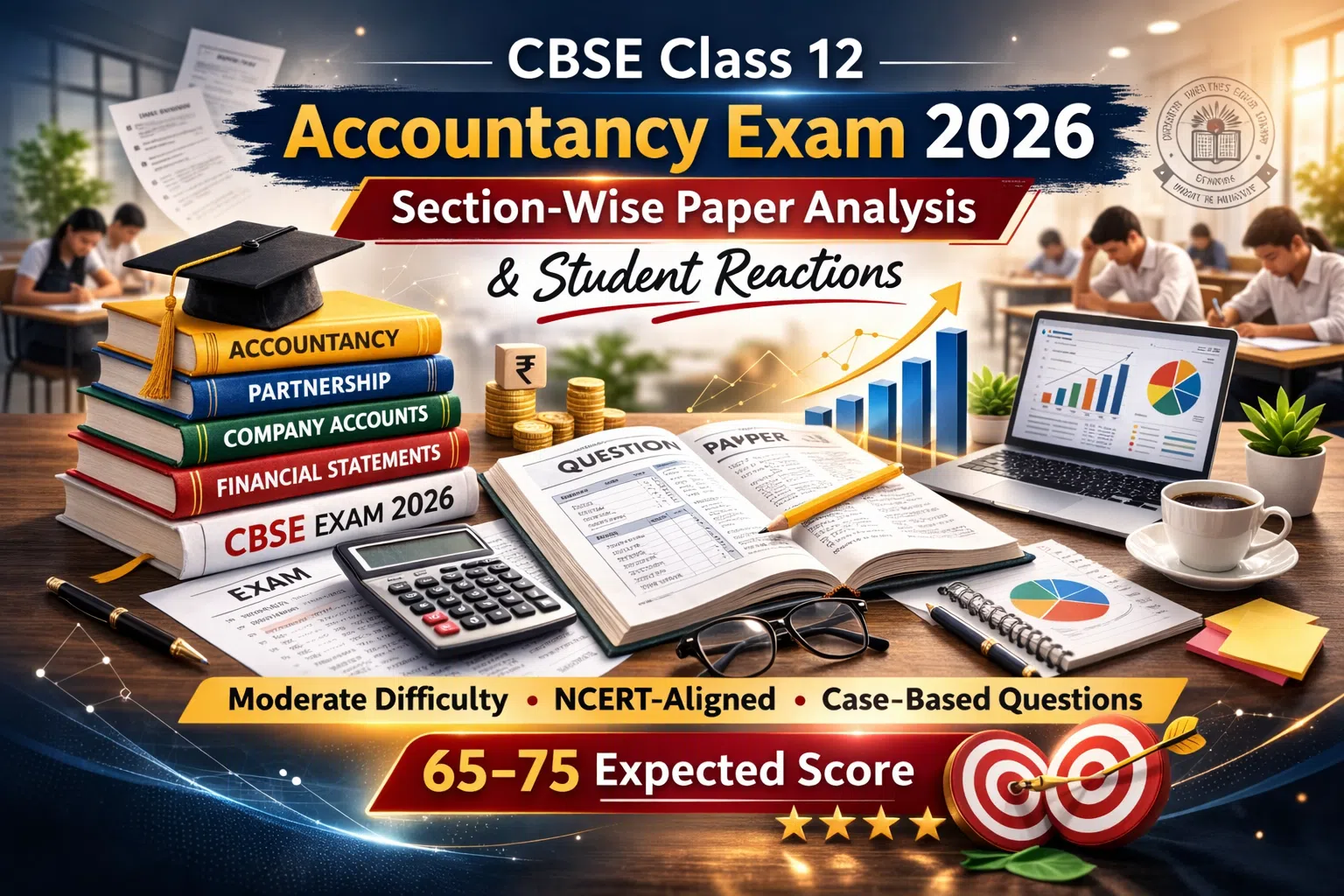
The CBSE Class 12 Accountancy Exam 2026 was rated Moderate Difficulty. The paper was fully NCERT-aligned, featured case-based assessment questions, and balanced theory with numericals. Well-prepared students found it manageable. Lengthy numericals tested time management, and case studies demanded real conceptual understanding.
Exam Overview: Quick Facts
| Factor | Analysis |
|---|---|
| Overall Difficulty | Moderate |
| Question Style | NCERT-Based, Blueprint-Aligned |
| Case Studies | Present — application-focused |
| Time Pressure | Moderate — highest in numericals |
| Numerical Complexity | Medium — procedural accuracy required |
| Theory Sections | Concept clarity over memorisation |
| Out-of-Syllabus Questions | None reported |
| Student Sentiment | Cautiously positive |
CBSE Class 12 Accountancy Paper Analysis Full
The CBSE Class 12 Accountancy Paper Analysis Full reveals a thoughtfully constructed exam that consistently asked why alongside how — and that distinction mattered. This wasn’t a paper that rewarded memorised formats. It rewarded genuine understanding.
Post-exam reviews confirmed that two questions carried slightly nuanced phrasing — deliberate, not careless — designed to test reading comprehension alongside subject knowledge. The numerical segment specifically challenged students to work accurately under time pressure, and the overall paper showed no deviations from CBSE’s officially declared blueprint.
The message is clear: CBSE is moving decisively toward application over memorisation, understanding over recall, and analytical thinking over textbook copying.
CBSE Class 12 Accountancy Paper Section-Wise Detailed Analysis
Part A — Partnership Firms
Difficulty: Easy to Moderate | Scoring Potential: High
For most students, this was the section where they found their rhythm. Questions covered the fundamentals of partnership, goodwill valuation methods, admission and retirement of partners, and dissolution — all core NCERT chapters that serious students had revised multiple times.
The case-based assessment within this section presented a business scenario involving partner adjustments, asking students to identify the correct accounting treatment. Students who had practised reading case-based questions carefully — rather than jumping to calculations — handled this well.
Common struggles here were arithmetic slips in profit-sharing calculations and missed adjustments in revaluation accounts. Conceptually, however, this section was manageable for prepared students.
Scoring Tip: Lay out your working clearly. Examiners award step marks here.
Part B — Company Accounts
Difficulty: Moderate | Scoring Potential: Moderate to High
Company Accounts required careful attention to detail. Issue of shares, forfeiture, reissue of forfeited shares, and debenture accounting featured prominently — and each carries the risk of cascading errors if the first entry is wrong.
The NCERT-aligned questions here were straightforward in concept but demanding in execution. Students who had genuinely practised the full journal-to-balance-sheet flow performed well. Those who had only memorised isolated entries found the multi-step questions unforgiving.
One interesting element: a question on debenture redemption required students to think through the logic of sinking fund entries rather than just reproducing a format — a classic application-over-recall design.
Scoring Tip: Don’t skip steps. Partial marking is generous if your working is visible.
Part C — Financial Statements & Cash Flow
Difficulty: Moderate to Time-Intensive | Scoring Potential: Moderate
This is where the clock became the real examiner. Financial statement analysis — particularly ratio analysis and the cash flow statement — demands methodical, multi-step work that eats into time quickly.
The cash flow statement, as reported in post-exam discussions consistent with Times of India’s coverage, required careful classification of operating, investing, and financing activities, plus adjustments for depreciation, working capital changes, and non-cash items. Students who had practised full cash flow problems under timed conditions moved through it. Those who hadn’t found themselves watching the clock more than their answer sheets.
Ratio analysis questions were formula-faithful — close NCERT alignment meant that any student who had studied the chapter properly could score here, provided they managed their time.
Scoring Tip: Attempt cash flow last if time management is a concern — it’s high-stakes but front-loadable after securing marks in cleaner sections.
Student Reaction Highlights
Outside exam centres from Delhi to Bhubaneswar, here’s what students said about the CBSE Class 12 Accountancy Paper:
- “Partnership was the most comfortable” — nearly universal reaction across cities
- “Cash flow took too much time” — the single most common complaint of the day
- “Case study questions needed you to read twice” — rushing cost marks; careful readers scored well
- “MCQs were fair — NCERT lines, not tricks” — students appreciated concept-based objective questions
- “I wish I had timed myself more during practice” — the most common regret
- “Overall it was a fair paper — I expected worse honestly” — the dominant post-exam mood
Expert Insight: What Educators Are Saying
Educators who reviewed the CBSE Class 12 Accountancy Paper Detailed Section-Wise Analysis shared three consistent observations:
Concept over format. The paper persistently rewarded students who understood the logic behind accounting entries — not those who had memorised formats without context.
Case-based questions are the new normal. The case-based assessment sections aren’t a novelty anymore — they’re a core part of CBSE’s evaluation design. Students who had not specifically practised application-style questions felt this gap sharply.
Time strategy separated scores. Multiple educators emphasised that students who walked in with a clear time allocation plan — “X minutes for partnership, Y for cash flow” — had a structural advantage regardless of preparation level.
The broader takeaway from the How Was The CBSE Class 12 Section-Wise Paper Analysis discussions: CBSE has clearly committed to testing analytical ability. Future batches need to plan accordingly.
What This Means for Commerce Students
Here’s a question worth sitting with: the exam tested application, case-based thinking, and analytical reasoning. Where do those skills lead next?
The answer, for Commerce students, is both exciting and expansive. Management, business analytics, FinTech, entrepreneurship, digital commerce — these aren’t distant aspirations. They’re realistic pathways for students who build on a strong Accountancy foundation with the right undergraduate education.
Two directions are commanding increasing attention among high-performing Commerce graduates:
Top BBA Colleges in India offer programs that transform financial and analytical thinkers into business leaders. A well-designed BBA program builds on exactly the skills CBSE is now testing — structured analysis, application thinking, and decision-making under uncertainty.
Top BCA Colleges in India are increasingly attracting Commerce students who want to combine their numerical aptitude with technology skills. With data analytics, FinTech, and digital business reshaping every industry, Commerce-plus-tech is one of the most powerful combinations in today’s job market.
Career Direction: Building on Your Commerce Foundation
If you’re a Commerce student thinking seriously about what comes next, Regional College of Management (RCM), Bhubaneswar is worth exploring closely.
RCM’s Industry-Integrated BBA PLUS Program isn’t a conventional management degree. It’s built around real business exposure — live projects, industry mentors, and a curriculum designed to produce professionals, not just graduates. For students who just spent three hours applying Accountancy concepts to real scenarios, this environment will feel like a natural continuation of that thinking.
RCM’s Tech-Driven BCA PLUS Program bridges commerce intelligence with programming, data analysis, and digital systems thinking — creating graduates who speak both business and technology fluently. In a world where every financial operation runs on software and every tech company needs business-savvy thinkers, this is an increasingly valuable intersection.
Both programs are part of RCM’s distinctive PLUS Programs framework — career-ready from Day 1, industry-connected throughout, and built for the analytical, application-first mindset that boards and employers alike are now demanding.
FAQs
The paper was rated Moderate — balanced, NCERT-aligned, and fair for well-prepared students.
Yes, the entire paper followed NCERT chapters closely with no out-of-syllabus questions reported.
Yes, case-based assessment questions were present across multiple sections, testing application over recall.
Moderate time pressure was felt, primarily in the cash flow statement and multi-step numerical sections.
A consistently prepared student aiming for NCERT mastery can reasonably target 65–75 out of 80 in theory.
Conclusion
The CBSE Class 12 Accountancy Exam 2026 wasn’t designed to trip students up. It was designed to find out who really understood what they studied. That’s a better kind of exam — and it reflects a better kind of education system.
For students who performed well today: your analytical thinking is an asset. Build on it deliberately. For students who found it tough: this paper just showed you exactly where to grow. Either way, what matters most now is the clarity of your next step.
The world ahead rewards students who can analyse, apply, and adapt — and it starts with choosing an undergraduate program that develops those exact capacities.
Admissions Open — Explore BBA & BCA PLUS Programs at Regional College of Management, Bhubaneswar. For the latest updates on education, college admissions, and career-ready programs — stay tuned with the RCM Blog Page.