A decade ago, a good financial analyst needed a sharp eye for numbers and a solid grasp of accounting. Today, that same analyst is expected to read a machine-learning model’s output, question a company’s carbon disclosures, and understand how a digital wallet in a small town changes a bank’s risk profile. Finance hasn’t just added new tools. It has changed what the job means.
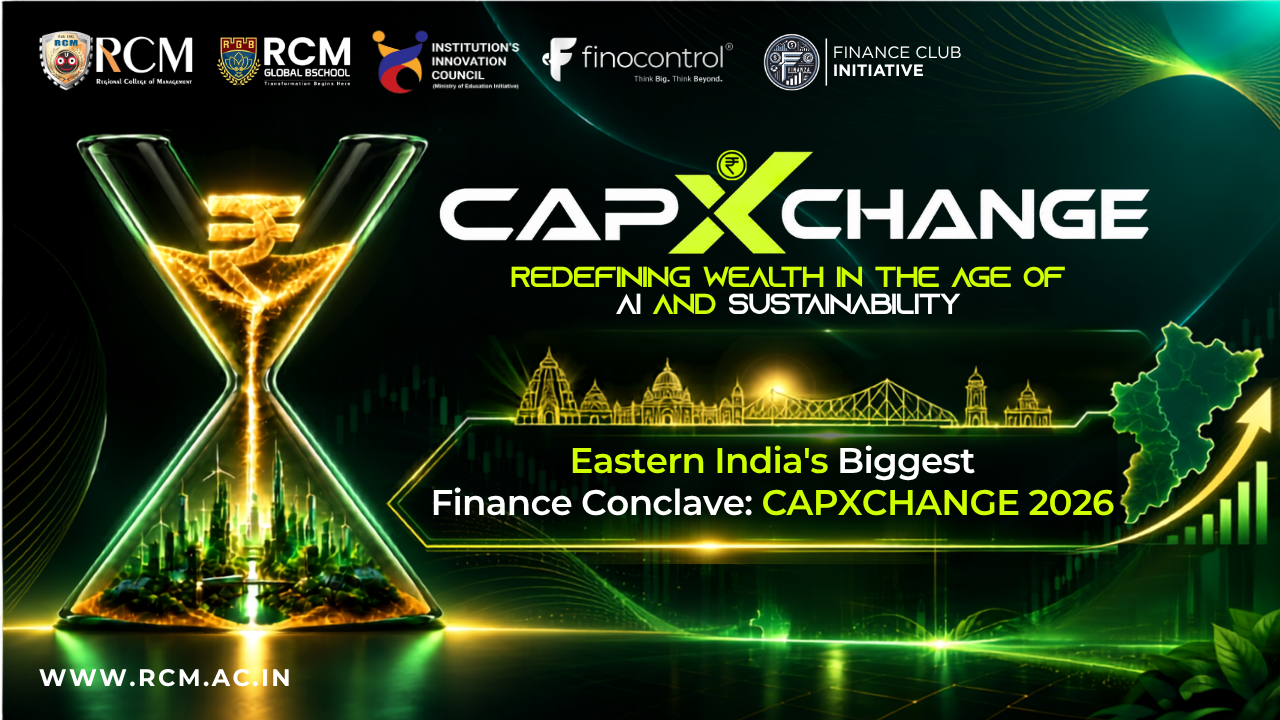
That shift, from capital management to intelligent, responsible decision-making, is exactly what CAPXCHANGE 2026 is built to explore. Hosted by Regional College of Management (RCM), Bhubaneswar, the Finance Conclave carries the theme “Green Finance, Smart Future: Redefining Wealth in the Age of AI and Sustainability”, a line that captures where the industry is actually heading rather than where it has been.
This article looks at what that theme means in practice, why AI and sustainability are increasingly discussed in the same breath, and how CAPXCHANGE 2026 turns that conversation into something students and professionals can actually engage with.
Table of contents
What Is CAPXCHANGE 2026?
CAPXCHANGE 2026 is a two-day Finance Conclave organised by Regional College of Management, Bhubaneswar, held on 18 September and 19 September 2026 at the RCM campus in Bhubaneswar, Odisha. It brings together students, finance professionals, academicians, corporate leaders and industry experts for keynotes, masterclasses, panel discussions and two student competitions built around financial modelling and financial technology.
Its purpose sits squarely in the academia-industry space: rather than treating finance education as a classroom-only subject, CAPXCHANGE puts students in direct contact with the people currently making decisions in government finance, central banking, consulting and asset management.
Understanding the Theme: “Green Finance, Smart Future”
The official theme isn’t a slogan bolted onto a conference banner. It’s really three connected ideas, each describing a real shift already under way in Indian and global finance.
Green Finance: Directing Capital Towards Sustainable Growth
Green finance, at its simplest, means channelling capital toward projects and businesses that reduce environmental harm: renewable energy, clean transport, sustainable agriculture and climate-resilient infrastructure. It isn’t a separate category of investing anymore so much as a lens applied to ordinary lending and investment decisions.
For Indian businesses and investors, this matters because green finance is increasingly tied to how capital gets priced. Lenders and investors are paying closer attention to a company’s environmental exposure when they assess long-term risk, not out of goodwill, but because climate-related disruption has real financial consequences. SEBI’s own data on ESG debt securities shows this shift is already visible at a market level in India, not just in boardroom conversation. That’s a meaningfully different starting point than the compliance-driven sustainability conversations of a decade ago.
Smart Future: How AI Is Reshaping Financial Decisions
The “smart” half of the theme points to artificial intelligence, and its footprint in finance is already broad. AI now supports financial forecasting, fraud detection, credit assessment, risk management, portfolio analysis and customer service, often working faster and at a larger scale than a human team could manage alone.
That said, the opportunity comes with genuine friction. Automated credit decisions raise questions about bias and fairness. Predictive models can be difficult to explain to a regulator or a customer. And concentrating financial decisions in a handful of AI systems introduces new categories of model and governance risk that institutions are still learning to manage, a concern the IMF has examined in detail in its work on generative AI in finance. CAPXCHANGE treats AI in finance as both an opportunity and a responsibility, not a solved problem.
Redefining Wealth in the Age of AI and Sustainability
Put the two ideas together and you get a different definition of wealth creation than the one most finance textbooks still teach. Long-term value increasingly depends on ESG considerations, exposure to climate risk, and how well a business uses technology to make informed, transparent decisions.
For students, this reframing matters because it changes what “doing well” in finance looks like. It’s no longer just about maximising short-term returns. It’s about building portfolios and businesses that can hold up over decades, not quarters, a shift the World Bank’s research on blended finance for climate investment in India frames as a genuine capital-allocation challenge rather than an ethical add-on.
Why the Future of Finance Requires AI and Sustainability Together
AI and sustainable finance aren’t separate trends running in parallel. They increasingly depend on each other. ESG reporting, for instance, generates enormous amounts of unstructured data on emissions, supply chains and governance practices, and AI-driven analysis is what makes that data usable at scale for investors and regulators.
The same overlap shows up in FinTech and financial inclusion. Digital banking platforms use predictive analytics to extend credit to previously underserved customers, but doing that responsibly requires deliberate, sustainability-aware design rather than growth for its own sake. It’s also why central banks are paying closer attention to AI’s systemic footprint, with the IMF noting that AI adoption is now a genuine financial-stability consideration rather than a back-office efficiency question alone. Wealth creation, in other words, is becoming a discipline that blends predictive technology with long-term, responsible judgement, which is precisely the combination CAPXCHANGE 2026 is structured around.
Key Themes Explored at CAPXCHANGE 2026
CAPXCHANGE organises its keynotes, masterclasses and competitions around a consistent set of themes:
- AI in Finance — forecasting, fraud detection, credit assessment and decision-support tools
- Green Finance and ESG Investing — capital allocation aligned with environmental and governance criteria
- Sustainable Finance — long-term value creation that accounts for climate and social risk
- FinTech and Digital Banking — digital payments, financial inclusion and banking infrastructure
- Wealth Management — evolving investment strategy in a technology-driven market
- Financial Modelling and Valuation — the analytical backbone of investment decision-making
- Financial Innovation — new products, platforms and business models in financial services
- Financial Inclusion and Responsible Wealth Creation — extending finance’s benefits more broadly and sustainably
Each of these gets treated as a working theme rather than a buzzword, largely because the conclave’s competitions ask students to apply them directly rather than simply discuss them.
CAPXCHANGE 2026 Schedule: Key Sessions to Watch
The two days follow a clear arc: Day 1 builds financial modelling skills through a structured competition, while Day 2 opens into industry-wide panel discussions and an innovation showcase.
| Day | Time | Session |
|---|---|---|
| Day 1, 18 Sep 2026 | 9:00 AM | Registration |
| Day 1 | 10:30 AM | Inaugural ceremony |
| Day 1 | 10:45 AM | Welcome address by convenor Prof. Soumyalin Santy |
| Day 1 | 10:50 AM | Keynote by Gokul Chandra Pati and Dr. Saurabh Garg |
| Day 1 | 11:30 AM | Guests’ felicitation |
| Day 1 | 12:00 PM | Round 1, Financial Modelling WorldCup |
| Day 1 | 12:10 PM | Masterclass 1 by industry leaders |
| Day 1 | 12:30 PM | Round 2, Financial Modelling WorldCup |
| Day 1 | 2:30 PM | Lunch |
| Day 1 | 3:30 PM | Round 3, Financial Modelling WorldCup, and Masterclass 2 |
| Day 1 | 5:00 PM | Final round: simulated investment-committee review |
| Day 1 | 6:00 PM | Close of Day 1 |
| Day 2, 19 Sep 2026 | 9:30 AM | Arrival of participants and guests |
| Day 2 | 10:15 AM | Welcome address by Prof. Satyanath Mohapatra |
| Day 2 | 10:25 AM | Keynote by Rupambara, former Director (Communications), RBI |
| Day 2 | 10:35 AM | Panel Discussion 1: AI-Powered Green Finance |
| Day 2 | 12:05 PM | Keynote by Vinayak Hulekal, Executive Director, EY GDS |
| Day 2 | 12:15 PM | Panel Discussion 2: Redefining Wealth |
| Day 2 | 1:40 PM | Lunch |
| Day 2 | 2:30 PM | Poster presentation competition |
| Day 2 | 3:00 PM | Poster evaluation round |
| Day 2 | 4:30 PM | Valediction ceremony and awards |
For the full session-by-session breakdown, every speaker profile and complete competition rules, RCM’s India’s Biggest Finance Conclave 2026 complete guide covers the event end to end.
Keynote Speakers and Industry Voices at CAPXCHANGE 2026
- Gokul Chandra Pati — Ex Chief Secretary, Odisha, Government of India
- Dr. Saurabh Garg — Secretary, Ministry of Statistics and Programme Implementation, Government of India
- Rupambara — Former Director (Communications), Reserve Bank of India
- Vinayak Hulekal — Executive Director, EY GDS
Panel 1, AI-Powered Green Finance: CA Riya Goyal, CMA Lokendra Shekhawat, Faraaz Dharamsey, CA Kajal Kathpalia and Dr. Shikta Singh.
Panel 2, Redefining Wealth: CA Sanjib Kumar Pani, Dr. Naresh Chandra Sahu, Biraja Tripathy and Anish Sharma.
From Theory to Practice: Competitions at CAPXCHANGE 2026
Keynotes and panels frame the theme, but CAPXCHANGE’s two competitions are where it gets tested directly by students.
Financial Modelling WorldCup
A multi-round, Excel-based challenge covering accounting, forecasting, DCF valuation, WACC and comparable-company and scenario analysis, contested by teams and judged by industry professionals. The competition carries a ₹50,000 cash prize pool, along with scholarship and discount benefits for top-performing teams.
Financial Technology Innovation
An individual or team poster-presentation format, with a five-minute pitch followed by a two-minute Q&A. Submissions span AI in finance, FinTech, ESG, digital banking, wealth management, cybersecurity, green bonds and financial inclusion. This track carries a ₹40,000 cash prize pool.
What Can Students Learn From CAPXCHANGE 2026?
Beyond the competitions themselves, CAPXCHANGE gives students a working sense of what the theme actually demands: practical financial modelling, AI-aware decision-making, ESG literacy, FinTech fundamentals, business valuation and the communication skills needed to defend an idea in front of industry judges. It also offers something harder to teach in a classroom: a direct read on what employers in finance, consulting and asset management currently expect from new graduates.
None of this guarantees a placement or a particular career outcome. What it does offer is a realistic, low-stakes preview of the skills the industry is actively hiring for.
How CAPXCHANGE Connects to RCM’s Academic Pathways
The theme’s three pillars map fairly directly onto specific learning pathways at RCM. Students drawn to the green finance and ESG conversation will find a natural fit in PGDM+ Green Finance & ESG (FinTech), while those interested in the AI and analytics side of the theme can explore PGDM+ Data Science & Business Intelligence.
For students focused on strategy and leadership, MBA+ Finance/FinTech builds on the panel discussions’ themes directly, while MCA+ AI and ML addresses the technology infrastructure behind modern financial services.
For students focused on strategy and leadership, MBA+ Finance/FinTech builds on the panel discussions’ themes directly, while MCA+ AI and ML addresses the technology infrastructure behind modern financial services.
Explore CAPXCHANGE 2026
CAPXCHANGE 2026 turns a genuinely current conversation, about AI, sustainability and the future of wealth, into a two-day event students and professionals can actually take part in. The full schedule, speaker list and registration details are available on the CAPXCHANGE 2026 Finance Conclave page.
FAQ
The official theme is “Green Finance, Smart Future: Redefining Wealth in the Age of AI and Sustainability.” It frames finance as a discipline now shaped by climate-conscious capital allocation, AI-driven decision-making and long-term, responsible wealth creation, rather than accounting and investment alone.
CAPXCHANGE 2026 runs on 18 and 19 September 2026 at Regional College of Management (RCM), Bhubaneswar, Odisha. Day 1 focuses on financial modelling, while Day 2 covers panel discussions, a poster pitch competition and the valediction ceremony.
Green finance directs capital toward climate-conscious growth, while AI enables faster, data-driven analysis of the ESG and risk information that decision now depends on. Together, they’re reshaping how lenders, investors and businesses assess long-term value.
CAPXCHANGE 2026 covers AI in finance, green finance and ESG investing, sustainable finance, FinTech and digital banking, wealth management, financial modelling and financial innovation, explored through keynotes, panels and student competitions.
Students gain hands-on exposure to financial modelling, AI-aware decision-making, ESG literacy and FinTech fundamentals, along with direct interaction with finance professionals from government, banking and consulting backgrounds through CAPXCHANGE’s competitions and panels.