The world is standing at the edge of a major transformation.
While businesses are still adapting to Industry 4.0, a new paradigm — Industry 5.0 — is already shaping the future of leadership, workforce strategy, and sustainable growth.
The shift from automation to human-machine collaboration is not just technological — it is deeply strategic.
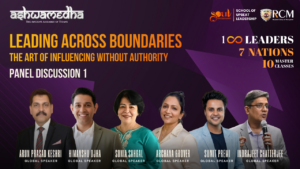
And this transition is becoming a central theme of global leadership conversations, including Ashwamedha 2026 — India’s Biggest Global Management Conclave, hosted by Regional College of Management.
Understanding Industry 4.0 vs Industry 5.0
To understand where the future is heading, we must first understand where we are coming from.
Industry 4.0 Focused On:
- Automation
- Artificial Intelligence
- IoT-enabled systems
- Smart manufacturing
- Data-driven efficiency
Industry 4.0 transformed operations by making machines smarter and processes faster.
Its goal was simple:
Improve productivity through automation.
Industry 5.0 Focuses On:
- Human-machine collaboration
- Sustainability
- Workforce wellbeing
- Resilient business models
- Personalized production
Instead of asking:
“How can machines replace humans?”
Industry 5.0 asks:
“How can technology empower humans?”
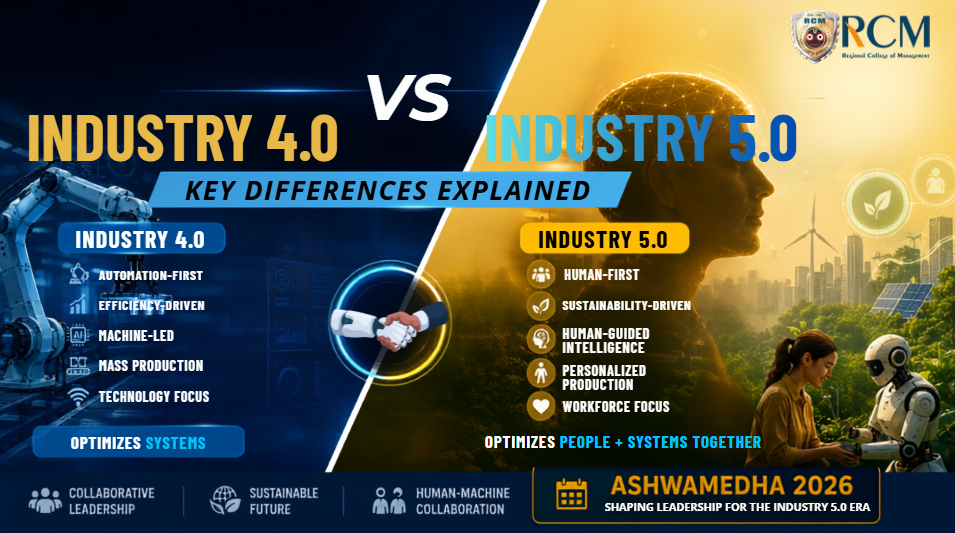
Difference Between Industry 4.0 and 5.0
| Industry 4.0 | Industry 5.0 |
|---|---|
| Automation-first | Human-first |
| Efficiency-driven | Sustainability-driven |
| Machine-led decision systems | Human-guided intelligence |
| Mass production | Personalized production |
| Technology focus | Workforce focus |
In simple terms:
Industry 4.0 optimized systems.
Industry 5.0 optimizes people + systems together.
Industry 5.0 Transformation: Why Leadership Must Evolve
Technology alone cannot drive Industry 5.0.
Leadership must evolve beyond automation thinking.
Future organizations must redesign:
✔ Workforce structures
✔ Decision-making frameworks
✔ Leadership models
Instead of managing processes, leaders must now manage collaboration between humans and intelligent systems.
This transition requires:
- Collaborative leadership
- Emotional intelligence
- Systems thinking
- Sustainability vision
These are precisely the conversations being explored at Ashwamedha 2026, where global leaders like:
- Dr. Ajay Brahmbhatt – India Lead, Siemens
- Vikas Singh Baghel – Associate Director HR, HCLTech
- Sanjeev Parker – Former CHRO, Cairn Oil & Gas
are discussing how organizations must prepare for the Industry 5.0 workforce era.
Workforce Redesign in the Industry 5.0 Era
Industry 4.0 automated jobs.
Industry 5.0 redesigns roles.
Future workforce structures will prioritize:
- Creativity
- Human judgment
- Ethical decision-making
- Adaptive collaboration
Organizations are shifting from task-based roles to capability-based roles.
Employees are no longer defined by:
“what they do”
But by:
“how they think, collaborate, and innovate”
The Future of Industry 5.0
The future of Industry 5.0 will not be built by engineers alone.
It will be built by:
- Strategists
- Designers
- Managers
- Sustainability leaders
- Human experience architects
This makes management education a critical driver of Industry 5.0 transformation.
Forward-looking institutions like Regional College of Management are already aligning their programs to this future through:
- Analytics-driven learning
- Leadership development
- Digital transformation exposure
These integrated learning models — available across programs listed on the RCM Programs Page — prepare students to thrive in collaborative technology environments.
Why Industry 5.0 Needs Collaborative Leadership
Industry 4.0 rewarded technical specialists.
Industry 5.0 rewards collaborative leaders.
Future-ready managers must:
- Bridge technology and people
- Balance efficiency with empathy
- Align innovation with sustainability
This is why leadership development is becoming as important as technical literacy.
At Ashwamedha 2026 — India’s Biggest Global Management Conclave, panels and masterclasses focus on:
➡ Human-centered leadership
➡ Workforce transformation
➡ Sustainable business strategy
Positioning the event as a platform shaping the future of Industry 5.0 leadership globally.
Industry 5.0 and Business Education
Traditional education prepared students for jobs.
Industry 5.0 education prepares students for evolving roles.
Business schools must now integrate:
- Technology understanding
- Human leadership skills
- Innovation thinking
- Sustainability strategy
Institutions like Regional College of Management are redefining management education by combining:
✔ Leadership
✔ Analytics
✔ Digital transformation
— ensuring graduates are ready for Industry 5.0 environments.
Frequently Asked Questions
Industry 4.0 focuses on automation and efficiency, while Industry 5.0 emphasizes human-machine collaboration, sustainability, and workforce wellbeing.
No. Industry 5.0 builds on Industry 4.0 by adding human-centric innovation and sustainability to technological advancements.
Key skills include emotional intelligence, systems thinking, leadership agility, sustainability awareness, and digital literacy.
Because future organizations will depend on collaborative leadership that integrates human creativity with intelligent technologies.
Leading institutions are integrating analytics, leadership, and digital transformation into management programs to prepare students for hybrid roles.
Final Thought
The transition from Industry 4.0 to Industry 5.0 is not just technological — it is cultural.
It marks the shift from machine-led growth to human-centered progress.
And as discussions at Ashwamedha 2026 — India’s Biggest Global Management Conclave highlight, the future will belong to leaders who can co-create value alongside intelligent systems.
The future of industry is not automation alone.
It is collaboration.